


 View Cart
1 min read
From Lab to FRQ: Designing Investigations That Build AP-Level Thinking
Professional learning specialist Katie Smith shows AP science teachers how to transform traditional “cookbook” labs into rich experiences that...

2 min read
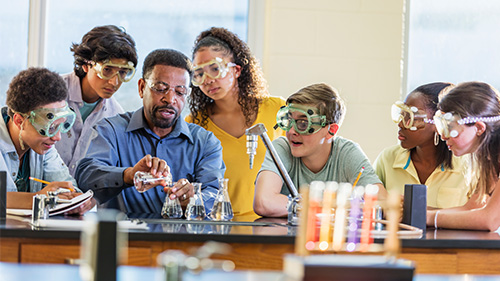
One of the biggest challenges AP Science teachers face is helping students connect lab skills to AP Exam free-response questions (FRQs). Students may be comfortable following procedures, collecting data, and answering post-lab questions—but when the exam asks them to design an investigation, justify a method, or analyze unfamiliar data, those skills are very difficult to transfer. But, with intentional shifts, your labs can double as powerful FRQ preparation without adding extra work to your plate.

AP Science FRQs assess content knowledge, but they also often require students to:
• Design controlled experiments.
• Identify variables and justify procedures.
• Analyze data and draw conclusions.
• Evaluate sources of error.
• Communicate scientific reasoning clearly.
When labs mirror these expectations, students begin to see investigations not as “activities,” but as preparation for the exam.
As you approach a lab, make the desired outcomes FRQ focused. Consider the following questions:
• What FRQ skill do I want students to practice?
• Which science practices does this lab reinforce?
• How might the AP Exam phrase this task?
For example, rather than prompting students to “Follow these steps to determine reaction rate,” frame the task as: Design an experiment to investigate how temperature affects reaction rate. This shift encourages students to think like both AP Exam writers and scientists. The more you can frame prompts and questions like FRQs, the more prepared students will be.
As the year continues, prompt students to design more and more parts of a lab investigation. Consider the following ways to shift cognitive responsibility onto your students:
• Giving students a lab structure and asking them to identify the variables and controls involved (and ask students why a control is necessary).
• Constructing a procedure with missing steps for students to determine how to complete it.
• Offering multiple experimental setups and asking students to identify and justify the best choice.
These approaches mirror common FRQ prompts and help students practice scientific decision-making.
Instead of limiting analysis to “calculate” and “describe,” try:
• Providing unfamiliar data sets (consider pulling from released FRQs) for students to analyze and draw conclusions from.
• Asking students to justify trends using evidence.
• Requiring written explanations with claim-evidence-reasoning (CER) or a similar structure.
These types of tasks both prepare students for the AP Exam and expand their ability to transfer scientific skills.
FRQs frequently involve some sort of error analysis, including:
• Identifying a source of error.
• Explaining how the error affects results.
• Proposing a modification to improve the experiment.
Make this thinking a standard lab component by:
• Asking students to identify specific errors (not just “human error”).
• Connecting errors directly to data outcomes.
• Having students revise a lab design as a reflection activity..
AP-aligned labs don’t need to be longer or more complicated. The key is intentional alignment, not overhaul.
Even one redesigned question per lab or one missing component that students need to determine in a procedure can prompt students to think more like both AP Exam writers and scientists.
When labs mirror AP Exam free-response tasks, students are less likely to see the exam as unfamiliar or intimidating. The AP Exam can become a natural extension of the work your students do all year. Design labs with the end in mind, and you’ll give students exactly what they need: authentic practice, deeper understanding, and confidence on exam day.

1 min read
Professional learning specialist Katie Smith shows AP science teachers how to transform traditional “cookbook” labs into rich experiences that...

1 min read
Chemistry is fundamentally about explaining how invisible molecular interactions shape the world we observe: micro and macro, structure and function....

1 min read
Environmental science is highly visual and deeply systems-based. Understanding everything from ecosystem interactions to sustainable practices to...

1 min read
Your students have already discovered vibecoding. The question is whether they understand what they're looking at when the AI spits out two hundred...

1 min read
One of the biggest challenges in AP Chemistry is helping students connect what happens at the molecular level with what they observe in the real world

1 min read
There is no shortage of professional development on teaching educators how to write questions. We add them to our lesson plans, we spin manual or...

1 min read
The Supreme Court of the United States is often seen as the most distant and befuddling branch for my students. Whether it is misunderstanding their...

1 min read
Just last week, my oldest son asked me what I wanted for Christmas. My answer? Nothing.

1 min read
Teaching AP Literature seems like an endless juggle between the forest and the trees. We want to guide students to enduring understandings, essential...
.jpg)
1 min read
Congratulations! You’re well into the first semester now. You’re developing new and solid relationships with your learners and creating a classroom...

1 min read
We’ve heard of Project-Based Learning (PBLs), which allows students to mostly have independent leadership through a task or project and creative...
1 min read
Transitional literacy focuses on bridging the gap between basic reading skills and more advanced literacy skills necessary for success during middle...