Skip to the main content
Perfection Learning

AP English

Help ALL your students achieve AP success with our coursebooks designed by leading experts.

AP & Honors Science

Guide students through real-world application of science concepts with Wiley’s advanced programs.

AP Social Studies

Discover a variety of accessible yet rigorous programs designed to align with AP social studies courses.

AP Computer Science

Prepare students for success on the AP Computer Science A exam.

AP & Honors Mathematics

Explore Wiley titles to support both AP and Honors mathematics instruction.

Literacy Skills & Intensive Reading

Connections: Reading – Grades 6–12

Empower student success with a proven intensive reading program that develops strong reading skills in striving readers.

Drama, Speech & Debate

Basic Drama Projects 10th Edition

Build students’ confidence and competence with comprehensive, project-based theatre instruction.

Literature

Connections: Literature

Support learners as they study dynamic, relevant texts and bring the richness of diverse voices to students through literature.

Middle School Preview | Shop
High School Preview | Shop
 

Literature & Thought

Develop critical thinking, reading, and writing across literacy themes, genres, historical eras, and current events.

Language Arts

Vocabu-Lit® – Grades 6–12

Help students build word power using high-quality contemporary and classic literature, nonfiction, essays, and more.


Connections: Writing & Language

Help students develop grammar, usage, mechanics, vocabulary, spelling, and writing and editing skills.

Reading/English Language Arts

Measuring Up to the English Language Arts Standards

Incorporate standards-driven teaching strategies to complement your ELA curriculum.

English Language Learners

Measuring Up for English Language Learners

Incorporate research-based best practices for ELLs with an approach that includes a focus on language acquisition strategies.

Mathematics

Measuring Up to the Mathematics Standards

Incorporate standards-driven teaching strategies to complement your mathematics curriculum.

Foundations

Measuring Up Foundations

Help students master foundational math skills that are critical for students to find academic success.

Reading Preview | Shop
Mathematics Preview | Shop

Science

Measuring Up to the Next Generation Science Standards

Give students comprehensive NGSS coverage while targeting instruction and providing rigorous standards practice.

Assessment

Measuring Up Live

Deliver innovative assessment and practice technology designed to offer data-driven instructional support.

World Languages

Social Studies

Science

Turtleback

Reinforced bindings of classroom novels and nonfiction for maximum durability with a lifetime guarantee.

SAT Prep

SAT Prep

Financial Literacy

Introduction to Personal Finance

Culinary Arts

Professional Cooking

Professional Baking

Welcome.

For a better website experience, please confirm you are in:

2 min read

Unplugged AI: Hands-On Activities for Students

Unplugged AI: Hands-On Activities for Students
GettyImages-2170617021 (1)
 
You don’t need fancy robots or coding kits to help kids understand AI.
 
In today’s digitally connected world, it may seem that learning about artificial intelligence requires extensive technology and a background in coding. But foundational AI concepts can be introduced in any elementary classroom—no screens required!  “Unplugged AI” embraces hands-on, no-tech strategies that spark curiosity, foster creative thinking, and lay a groundwork for digital literacy.
 

Why Teach AI Without Screens?

 
Accessibility for Every Classroom: Not every school is equipped with tablets, laptops, or programmable robots. Unplugged AI activities ensure that all learners, regardless of resources, experience key computational thinking skills.
 
Developmentally Appropriate: Young children learn best through play and exploration. Abstract coding and digital algorithms can be daunting, but when students act out algorithms or sorting processes, they experience AI principles in a concrete, age-appropriate way.
 
Imagination and Collaboration: Unplugged activities invite students to use their creativity, communicate in groups, and solve problems together.
 

Engaging Sample Activities


1. Sorting Game: Students take on the role of “AI classifiers.” Provide a mix of objects (shapes, animals, or vocabulary words) and ask students to sort them into groups using different “rules,” just like a machine learning model “classifies” data.

 
2. Yes/No Guessing Game: Have one student think of an object, while classmates ask yes/no questions to guess what it is. This mirrors how some AI systems use elimination and logic to arrive at an answer, step by step.
 
3. Error Spotting: The teacher deliberately gives incorrect answers, such as calling a triangle a square, and prompts students to “correct the machine.” This not only highlights how AI systems can make mistakes, but also leads to valuable conversations about bias and accuracy in technology.
 
4. Art Bot Challenge: Write out a simple “algorithm”—a set of step-by-step drawing directions—and have students follow them exactly to create a picture. This activity illustrates that computers, like students, only do exactly what they’re told! 😉
 

 Making Cross-Curricular Connections Unplugged


AI isn’t just about computer science. It strengthens learning across subjects:

Literacy: Encourage creative writing with prompts like “Describe a friendly robot” or “Invent a machine for the future.” 

Mathematics: Use pattern recognition games or sorting tasks to reinforce foundational math concepts.

Science: Relate AI activity to larger scientific ideas, such as using data to predict weather patterns or sorting living things in an ecosystem.

Making It Stick—Reflection and Journaling After activities:


Reflection or Journal Questions:

  • What did you learn about how computers ‘think’?
  • If you could build an AI helper for your classroom, what would it do?
  • After learning about AI, are you more excited or nervous about using it in the future? Why? 
  • What do you think AI (artificial intelligence) means in your own words?
  • How is AI similar to the way people think or learn?
  • How is AI different from the way people think or learn?
  • Can computers make mistakes? Why or why not?
  • If an AI gives the wrong answer, how would you help it improve?
  • Do you think AI always makes fair decisions? What could make it unfair?
  • What rules would you give your AI helper to keep it safe and kind?
  • Do you think AI can be a good teammate in learning? Why or why not?
  • What should people remember when using AI to solve problems?

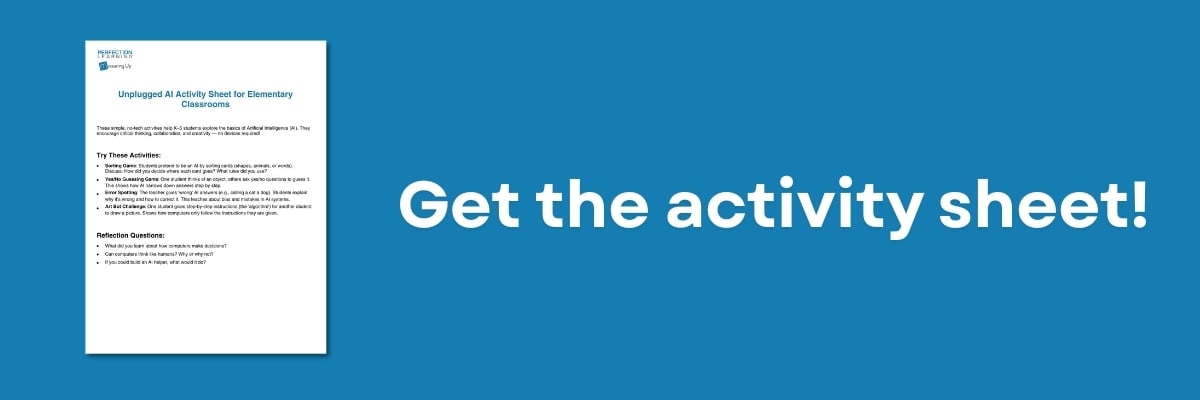
 With unplugged activities, every elementary classroom can develop foundational digital literacy. Ready to get started? Download a free unplugged AI activity sheet, or share your own classroom experiments with our educator community. Together, we can make AI education accessible, developmentally appropriate, and fun for all learners

 New call-to-action


Related blog posts