


 View Cart
1 min read
AP® Gov: Understanding Data Literacy Through Exit Polls
One of the most critical skills students will need on the AP® United States Government Exam is data literacy. Not only will there always be a...

4 min read
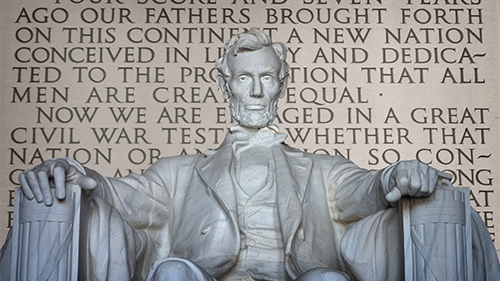
The addition of the Gettysburg Address to the AP U.S. Government and Politics required foundational documents is one of the most meaningful changes the College Board ® has made in recent years. While students have long encountered Abraham Lincoln's famous speech in U.S. history courses, its inclusion in AP Government signals that it should be studied not merely as a historical artifact, but as a constitutional and civic text. In just 272 words, Lincoln reframed the purpose of American government, redefined the meaning of equality, and articulated a vision of democracy that continues to shape political debates today.
The question for AP Government teachers is not whether the Gettysburg Address belongs in the course, but how to integrate it into an already crowded curriculum. Rather than treating it as a stand-alone reading, I believe it should appear throughout the year because it illuminates several of the course's foundational concepts.

The most natural home for the Gettysburg Address is Unit 1, where students are introduced to the principles of American democracy. One of the first questions we ask students is, "What is the purpose of government?" Lincoln provides one of the most enduring answers in American political thought. He reminds the nation that it was "conceived in Liberty, and dedicated to the proposition that all men are created equal." In doing so, he shifts students' attention away from government as merely a collection of institutions and toward government as the guardian of democratic ideals.
The speech also provides an important corrective to a common misconception. Many students assume that the Constitution is the sole foundation of American government. Lincoln deliberately begins not with the Constitution but with the Declaration of Independence. His famous reference to "four score and seven years ago" points to 1776 rather than 1787, emphasizing that equality is the nation's founding principle. This distinction helps students understand why AP Government studies both constitutional design and the ideals that give that design legitimacy. As I plan to teach into this, it may be useful to remind students, as Lincoln did to the nation, that the golden apple of our nation is the Declaration of Independence, with a silver frame of the Constitution.
The Gettysburg Address also fits naturally into Unit 3 on Civil Rights and Civil Liberties. Although the speech never mentions slavery directly, it fundamentally redefines the Civil War as a struggle over equality rather than simply preserving the Union. This provides students with an opportunity to examine how political leaders interpret the nation's founding ideals during moments of crisis.
One activity I plan to use asks students to compare the Declaration of Independence, the Gettysburg Address, the Fourteenth Amendment, and Dr. martin Luther King Jr.'s "Letter from Birmingham Jail." Students identify how each document builds upon the idea of equality while responding to the challenges of its own historical moment. Rather than viewing these texts as isolated readings, students begin to see an ongoing constitutional dialogue about who belongs within the American political community and how government should protect individual rights. Watching how the idea of equality has evolved in the course of American History while identifying continuity is especially powerful.
Another excellent placement is Unit 2, when discussing the presidency. Although the Gettysburg Address is not a legal document or executive order, it demonstrates one of the president's most important informal powers: shaping public opinion and defining national purpose. AP Government often focuses on the president's formal constitutional powers, but Lincoln's speech reminds students that presidential leadership also depends on persuasion. While the notion of the bully pulpit was developed under Teddy Roosevelt, this is a clear example of the bully pulpit at play.
In fewer than three minutes, Lincoln accomplished what lengthy policy speeches often cannot. He transformed a military cemetery dedication into a national statement about democracy itself. This creates an opportunity to discuss the rhetorical presidency and compare Lincoln's use of public address with speeches such as Franklin Roosevelt's First Inaugural Address, Ronald Reagan's Challenger disaster remarks, or Barack Obama's speech in Selma. Students can evaluate how presidents use language to unify the nation, justify policy, or redefine constitutional values. The power of the presidency is often referred to as the power to persuade, and these are clear examples of this.
The speech also lends itself to rich discussions about constitutional interpretation. Lincoln never argues that equality is a new American value. Instead, he presents it as the nation's original promise, one that had yet to be fully realized. This invites students to consider an enduring constitutional question: Should the Constitution be interpreted according to its original meaning, or should our understanding of its principles evolve as society changes? Lincoln's address provides an excellent historical example of how political leaders reinterpret founding ideals without rewriting the Constitution itself.
Assessment opportunities are plentiful. Students might explain how the Gettysburg Address reflects the principles of the Declaration of Independence, analyze Lincoln's conception of democratic government, or compare his understanding of equality with another required foundational document. These tasks reinforce both content knowledge and the analytical skills students need for the AP Exam.
Ultimately, the Gettysburg Address deserves its place in AP Government because it reminds students that government is about more than institutions, procedures, and powers. It is also about ideals. Lincoln challenges Americans to ensure that democratic government remains worthy of its founding principles and asks each generation to complete what he called "the unfinished work."
For teachers, that is perhaps the greatest opportunity presented by this addition. Rather than teaching the Gettysburg Address as a famous speech students memorize for history class, we can use it as a recurring touchstone throughout the course. Whether discussing constitutional principles, presidential leadership, civil rights, or civic participation, Lincoln's words invite students to think beyond how government works and toward the deeper question of what American government exists to achieve. That is a lesson that belongs at the heart of every AP Government classroom.
Pat Sprinkle is a 18th year history teacher at the NYC Lab School for Collaborative Studies, teaching AP® U.S. History and AP U.S. Government and Politics. Pat is a graduate of The Ohio State University and Columbia University. Pat has served as a member of the Teacher Advisory Council for the Bill and Melinda Gates Foundation, National Humanities Center, and the National Constitution Center. In addition, Pat was a 2013 James Madison Fellow along with a 2021 C-SPAN Fellow. Pat lives in Jersey City, New Jersey, with his wife, son (Franklin), and dog (Lyndon).

1 min read
One of the most critical skills students will need on the AP® United States Government Exam is data literacy. Not only will there always be a...

1 min read
The Supreme Court question on the AP Government exam, a mandatory component, consistently challenges students to demonstrate a nuanced understanding...

1 min read
Just last week, my oldest son asked me what I wanted for Christmas. My answer? Nothing.

1 min read
On the day after state testing, one of my sophomores burst into the room and announced: “Mr. G, I used rule of three on my essay.” It was a proud...
1 min read
One of the most important goals of civics education is to get students to understand the imperfections of the constitutional system of the United...

1 min read
For the past two weeks on my morning runs, I’ve been listening to the podcast Christmas Wars: A Very Merry Rivalry on the battle for Christmas movie...
1 min read
The Free-Response Question (FRQ) portion of the Advanced Placement® exam provides test takers with the opportunity to demonstrate their knowledge on...

1 min read
Most of the time, grading a stack of essays feels like shoveling a pile of smoke for the weekend. Not only are traditional grading methods...

1 min read
“The December spiral … prevents us from seeing the slow, meaningful gains our students are actually making.”

1 min read
For most of the past year and half, I have spent most of my waking hours querying or obsessing over querying literary agents for my young adult novel

1 min read
Before transitioning away from life as a public school educator, I worked as the academic trainer for English and social studies in a large, urban...
1 min read
The argumentative essay question on the AP U.S. Government and Politics exam demands a synthesis of content knowledge, analytical skill, and...