


 View Cart
1 min read
Women's History Month: Powerful Women
If we all trace our lineage back generation by generation, you will almost always find a fearless woman at the forefront of care, kindness, and the...

2 min read
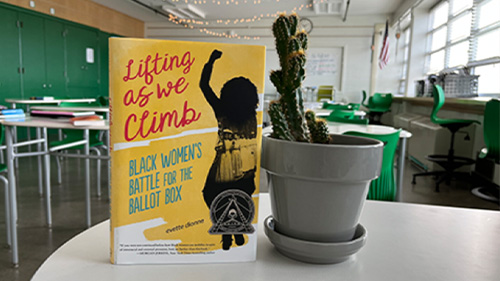
My favorite thing about Lifting As We Climb: Black Women’s Battle for the Ballot Box by Evette Dionne is that it’s accurate, and the author highlights Black women who fought hard during the Women’s Suffrage era to get women of color to the ballot box and voting in American elections. It’s not just women we’ve heard about like Susan B. Anthony and Elizabeth Cady Stanton, it’s women highlighted in the preface and throughout the book that tell the stories of the Black women we don’t know but who made a big difference.
I urged people to place “I Voted” stickers on the graves of Black suffragists like Sojourner Truth, Frances Ellen Watkins Harper, Nannie Helen Burroughs, Shirley Chisholm, and Fannie Lou Hamer, who have fought for generations, from the end of legal enslavement in the United States to the present day, to help secure voting rights for Black people. Whether it was creating organizations that helped elect Black congresspeople, as Anna Julia Cooper did when she cofounded the Colored Women’s League, or running for office, as Chisholm did when she became the first Black woman to be elected to Congress, or encourage Black people to register to vote during the Civil Rights Movement, as Hamer did, Black women have put themselves in the line of fire over and over again. Yet, when people learn about the long fight for women’s suffrage in the United States, it’s often an incomplete lesson. (2–3)
In this lesson, we will be honoring the Black women mentioned in the preface above and spotlighted throughout this book because, like Dionne said, they are integral to Black history as well as American history.
Mini Lesson
Interested in buying any of the books mentioned in this post? Visit our classroom libraries page.
Download the lesson below to easily print or save!

Jennifer Epping is a high school English and journalism teacher in Des Moines, Iowa. She has a passion for reading, writing, and making lame jokes to her students just to see them laugh or roll their eyes. She just concluded her ninth year teaching. Epping graduated from Iowa State University with a BS in journalism and mass communication (2010) and BA in English Education (2013). She attended New York University’s Summer Publishing Institute (2010), and spent some time in children’s book publishing in New York.
1 min read
If we all trace our lineage back generation by generation, you will almost always find a fearless woman at the forefront of care, kindness, and the...
1 min read
In Kimberly Brubaker Bradley’s Fighting Words, 10-year-old protagonist Della gives readers a front row seat to her daily life in foster care with her...
1 min read
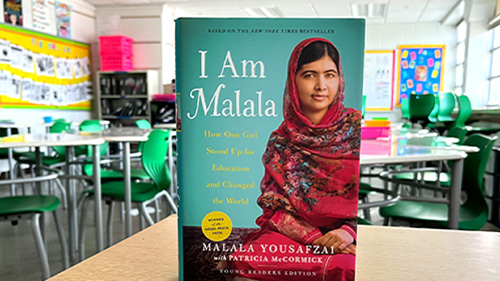
In recent months, the Taliban in the Middle East has taken over once again after American troops removed themselves. The first person I thought of...
1 min read
Join us for a conversation in partnership with Simon & Schuster with women YA and children's authors about the experience of being a woman in the...
1 min read
Dynamic and flat characterization has been in language arts and English curricula forever, it seems. How do we up the rigor as students advance in...
1 min read
The main character in The Girl with the Louding Voice by Abi Daré, Adunni, is on a personal journey to give herself the best life she can despite...
1 min read
Join us for a conversation in honor of Women's History Month in partnership with Simon & Schuster with authors Alicia D. Williams, Priyanka Taslim,...

1 min read
March is Women's History Month, and this year Perfection Learning® is celebrating by highlighting stories that feature strong women. Strength is...

1 min read
In celebration of Women's History Month, explore this lesson with your students that gives them the opportunity to practice an important part of the...
1 min read
I know sometimes it can be a struggle to get kids excited about nonfiction. Even I find myself more drawn to the escapism of fiction. But our world...
1 min read
Megan Rapinoe is a well-known women’s soccer player who has helped the U.S. women’s team win two World Cups, won an Olympic gold medal, and...

1 min read
Your Bow Tie Literacy Guy Michael Guevara is showcasing his favorite book pairings! Add these titles to your classroom library and download an...