Skip to the main content
Perfection Learning

AP English

Help ALL your students achieve AP success with our coursebooks designed by leading experts.

AP & Honors Science

Guide students through real-world application of science concepts with Wiley’s advanced programs.

AP Social Studies

Discover a variety of accessible yet rigorous programs designed to align with AP social studies courses.

AP Computer Science

Prepare students for success on the AP Computer Science A exam.

AP & Honors Mathematics

Explore Wiley titles to support both AP and Honors mathematics instruction.

Literacy Skills & Intensive Reading

Connections: Reading – Grades 6–12

Empower student success with a proven intensive reading program that develops strong reading skills in striving readers.

Drama, Speech & Debate

Basic Drama Projects 10th Edition

Build students’ confidence and competence with comprehensive, project-based theatre instruction.

Literature

Connections: Literature

Support learners as they study dynamic, relevant texts and bring the richness of diverse voices to students through literature.

Middle School Preview | Shop
High School Preview | Shop
 

Literature & Thought

Develop critical thinking, reading, and writing across literacy themes, genres, historical eras, and current events.

Language Arts

Vocabu-Lit® – Grades 6–12

Help students build word power using high-quality contemporary and classic literature, nonfiction, essays, and more.


Connections: Writing & Language

Help students develop grammar, usage, mechanics, vocabulary, spelling, and writing and editing skills.

Reading/English Language Arts

Measuring Up to the English Language Arts Standards

Incorporate standards-driven teaching strategies to complement your ELA curriculum.

English Language Learners

Measuring Up for English Language Learners

Incorporate research-based best practices for ELLs with an approach that includes a focus on language acquisition strategies.

Mathematics

Measuring Up to the Mathematics Standards

Incorporate standards-driven teaching strategies to complement your mathematics curriculum.

Foundations

Measuring Up Foundations

Help students master foundational math skills that are critical for students to find academic success.

Reading Preview | Shop
Mathematics Preview | Shop

Science

Measuring Up to the Next Generation Science Standards

Give students comprehensive NGSS coverage while targeting instruction and providing rigorous standards practice.

Assessment

Measuring Up Live

Deliver innovative assessment and practice technology designed to offer data-driven instructional support.

World Languages

Social Studies

Science

Turtleback

Reinforced bindings of classroom novels and nonfiction for maximum durability with a lifetime guarantee.

SAT Prep

SAT Prep

Financial Literacy

Introduction to Personal Finance

Culinary Arts

Professional Cooking

Professional Baking

Welcome.

For a better website experience, please confirm you are in:

2 min read

Real-Life Connections to AP® Free Response Questions

Real-Life Connections to AP® Free Response Questions

To reinforce essential AP Free Response skills (argumentation, rhetorical analysis, synthesis) by having students connect question types and strategies to things they already know—such as pop culture, current events, personal experience, or other academic content.

By the end of this lesson, students will be able to:

  • Identify the core expectations of AP FRQs (Q1–Q3).
  • Apply those expectations to nontraditional texts or real-life topics.
  • Practice creating thesis statements, evidence connections, and analytical explanations.
  • Reflect on their own strengths and strategies for each type of FRQ.

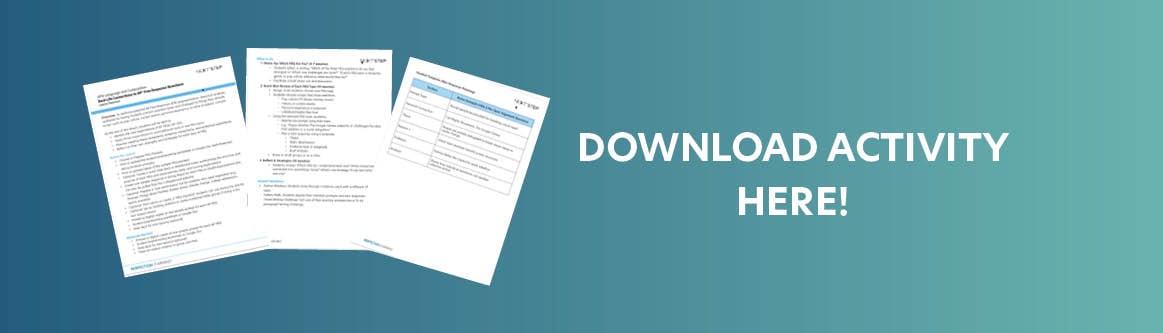
DownloadActivityButton_RealLifeConnectionsToAPFreeResonseQuestions_LPeterson

Before the Lesson

  • Choose or Prepare FRQ Prompts

  • Print or upload the student brainstorming worksheet or Google Doc (with thesis/evidence/analysis prompts)
  • Print or upload copies of the sample FRQ prompts
  • Optional: Create a quick slide deck or whiteboard notes summarizing the structure and purpose of each FRQ and showcase key verbs and scoring expectations
  • Create one sample response or strong thesis for each FRQ to model expectations (this can also be pulled from the Collegeboard website)
  • Optional: Prepare a “real world topics” list for students who need inspiration (e.g., Stranger Things, Black Panther, Barbie movie, climate change, college admissions, sports scandals)
  • Optional: Print rubrics or create a “FRQ checklist” students can use during the activity
  • Optional: Set up rotating stations or create numbered table groups if doing a station-based version
  • Printed or digital copies of one sample prompt for each AP FRQ
  • Student brainstorming worksheet or Google Doc
  • Slide deck for mini-lessons (optional)
  • Timer for station rotation or group activities
  • Students reflect in writing: “Which of the three FRQ questions do you feel strongest in? Which one challenges you most?” “If each FRQ were a character, genre, or pop culture reference, what would they be?”
  • Facilitate a brief share-out and discussion.
  • Use a slide or whiteboard to quickly review:
    • FRQ Q1 (Synthesis): Argue using provided sources
    • FRQ Q2 (Rhetorical Analysis): Analyze rhetorical choices
    • FRQ Q3 (Argument): Argue without sources
  • Provide an example prompt for each and have students jot down:
    • What the question is asking?
    • What kind of knowledge or strategy is most useful?

Materials Needed

  • Printed or digital copies of one sample prompt for each AP FRQ
  • Student brainstorming worksheet or Google Doc
  • Slide deck for mini-lessons (optional)
  • Timer for station rotation or group activities

What To Do

1. Warm-Up: Which FRQ Are You? (5–7 minutes)

  • Students reflect in writing: “Which of the three FRQ questions do you feel strongest in? Which one challenges you most?” “If each FRQ were a character, genre, or pop culture reference, what would they be?”
  • Facilitate a brief share-out and discussion.

2. Quick Mini-Review of Each FRQ Type (10 minutes)

  • Use a slide or whiteboard to quickly review:
    • FRQ Q1 (Synthesis): Argue using provided sources
    • FRQ Q2 (Rhetorical Analysis): Analyze rhetorical choices
    • FRQ Q3 (Argument): Argue without sources
  • Provide an example prompt for each and have students jot down:
    • What is the question asking?
    • What kind of knowledge or strategy is most useful?

3. “Make It Make Sense” Activity Instructions (25–30 minutes)

  • Assign or let students choose one FRQ type.
  • Students choose a topic they know well—from:
    • Pop culture (TV shows, movies, music)
    • History or current events
    • Personal experience or passions
    • Literature/media they love
  • Using the selected FRQ style, students:
    • Rewrite the prompt using their topic
      e.g., "Argue whether The Hunger Games supports or challenges the idea that rebellion is a moral obligation.”
    • Plan a mini-response using a template:
      • Thesis
      • Main idea/reason
      • Evidence (real or imagined)
      • Brief analysis
  • Share in small groups or as a class.

4. Reflect & Strategize (10 minutes)

  • Students answer: Which FRQ do I understand best now? What clicked when I connected it to something I know? What’s one strategy I’ll use next time I write a real one?

Optional Variations:

  • Station Rotation: Students move through 3 stations, each with a different FRQ and topic.
  • Gallery Walk: Students display their rewritten prompts and mini-responses.
  • Timed Writing Challenge: Turn one of their practice prompts into a 15-minute paragraph-writing challenge.

ProductPageBlogButtons (2)

Related blog posts