View Cart
1 min read
Six Word Memoir Activity
In this creative and reflective assignment, you’ll explore the art of powerful storytelling through just six words. You’ll examine examples of 6-word...

2 min read

In my district, every nine weeks we ask our students at all grade levels to read a work independently and then demonstrate their knowledge of that text. I found that in those first few weeks of school, my AP Literature students struggled to apply the concepts we were learning in class to novels and plays without instructional support. In addition, these early assignments also took away the support my students needed most– one another. Reading, while a solitary activity, is also inherently social. My favorite works of literature are those I have had the chance to explore in discussion with others.

However, just because students struggle to read independently doesn’t mean we should do it less frequently; if anything, we should ask them to read independently more often. We just need to develop better scaffolds to support our students as they climb the ladder of critical thinking and literary analysis. Several years ago, I got inspired to create a Short Story Literary Circles project to help my students connect and to reinforce the skills we were working on together. I laid out scavenged white table cloths, some gold platters, and buy-one-get-one-a-penny roses from the local grocery store. I made a menu, put on an apron, and hosted a short story tasting in Cafe 2416– a.k.a–my classroom.
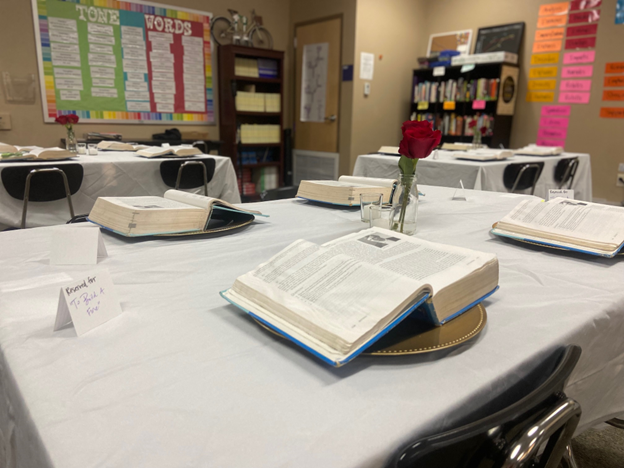
Now, some years I do not have the time to create a fine dining experience, but I have found that regardless of the ambiance, students enjoy the chance to sample some short stories before selecting one to study more closely. It is not uncommon for students to ask after class if we will do this again because they just cannot decide what to order!
In my own classroom, this work happens following the CED Unit 1: Short Fiction I, and students complete the reading and annotations independently. As we continue into Unit 2: Poetry I, I set aside time time for students to work in literary circles once or twice a week with the expectation that they arrive ready to share their ideas and progress. I could also see these materials working as in class assignments as well. There are endless opportunities to condense or expand this concept. You know what is best for your students!
All of the students’ work is geared around addressing the final prompt:
Read the short story __________ by __________. Then write a well organized essay in which you analyze how the author uses literary techniques and devices to portray development of a main character and how that character adds to the meaning of the work as a whole.
Here is a sample schedule aligned with the included materials:
Below are some materials to get you started if you would like to host your own Short Story Literary Circles:
Short Story Character & Theme Charts
Short Story Discussion Questions
Line of Reasoning Essay Outline
Please note that this unit uses the following stories: “The Yellow Wallpaper” by Charlotte Perkins Gillman, “To Build a Fire” by Jack London, “The Five Forty Eight” by John Cheever, “Sweat” by Zora Neal Hurston, and “Cathedral” by Raymond Carver. Feel free to adapt this project to meet your own classroom’s needs! If you use any of these materials, be sure to comment and share what works for your students.

1 min read
In this creative and reflective assignment, you’ll explore the art of powerful storytelling through just six words. You’ll examine examples of 6-word...

1 min read
Teaching AP Literature seems like an endless juggle between the forest and the trees. We want to guide students to enduring understandings, essential...

1 min read
When it comes to assessments in English classrooms, many teachers fall in the routine of short answer questions, multiple choice questions, and...

1 min read
Read. Annotate. Discuss. Write an essay. Rinse and repeat. Sometimes the most direct path is the best path. My classroom is often “un-instagramable.”...

1 min read
There is no shortage of professional development on teaching educators how to write questions. We add them to our lesson plans, we spin manual or...

1 min read
Students often rely on summaries as a shortcut to understand literature. While summaries help review the plot, they flatten storytelling into a list...

1 min read
A clear, defensible line of reasoning is what turns scattered insights into a cohesive, high‑scoring AP Lit essay. This worksheet helps students...

1 min read
think of teaching an AP Course, especially AP Literature, as similar to training for an endurance sporting event. The first several months you are...

1 min read
Transitional literacy focuses on bridging the gap between basic reading skills and more advanced literacy skills necessary for success during middle...

1 min read
Dr. Brandon Abdon and guest Clair Antoon-Newton to dig into why test scores jumped on the 2022 AP Literature Exam, standards setting, and what it all...

1 min read
If you teach grades 6–12 ELA, you know the squeeze. You are expected to move students toward sophisticated analysis of theme, rhetoric, structure,...