


 View Cart
 Dr. Brandon Abdon

1 min read
But What Does It Do? Rhetorical Analysis with David Jolliffe
Dr. David Jolliffe walked through the origins of his widely shared rhetorical framework, how he teaches it today, and why every rhetorical analysis...
I’ve chosen a tired metaphor for this, but it really does work (and is less ominous than the first one that came to mind: icebergs). Picture a duck gliding across a pond. Above the surface, everything looks effortless. The duck moves forward, apparently without doing much of anything. Beneath the surface, however, its feet are paddling away, propelling it through the water.


Arguments are a lot like ducks.
Students often encounter an argument as a finished product: words arranged into sentences, sentences organized into paragraphs, and paragraphs assembled into a text. They see what's on the page, but they don't necessarily recognize everything happening beneath the surface. All of the strategy and intention that went into—or that “underlie”—the choices the writer made.
Why did the writer choose that particular word? Why introduce an anecdote before presenting statistics? Why acknowledge a counterargument at this moment rather than earlier? What does the writer expect the audience to think, feel, or do as a result?
These questions get at the heart of teaching rhetoric and composition.
 Our goal is not simply to teach students how to recognize the features of an argument. It's to help them understand how an argument works—and how to make one work themselves.
Professor Emeritus from the University of Arkansas (and former chief reader for the AP English Language exam) David A. Jolliffe's “Rhetorical Framework” offers a particularly useful way to make that otherwise invisible work visible.
Writing Is More Than Putting Words on Paper
One of the challenges of teaching composition in any course and at any level is that writing can appear deceptively straightforward. Students receive a prompt, develop a claim, provide evidence, and submit an essay. Easy enough, right?
But writing is not simply the production of a text. It is an act of communication occurring within a particular rhetorical situation and a broader context. And those circumstances shape everything from the argument a writer develops to the individual words they choose.
In his 1995 chapter, "Discourse, Interdiscursivity, and Composition Instruction," published in Joseph Petraglia's Reconceiving Writing, Rethinking Writing Instruction, Jolliffe explores the relationship between discourse and composition instruction. His work contributes to a larger scholarly conversation that challenges us to think beyond generalized approaches to teaching writing and consider how writing operates within particular situations and communities.
Central to this discussion is the concept of interdiscursivity, which directs our attention to the relationships among different discourses and the ways they intersect. Rather than treating arguments as isolated products, we can recognize them as contributions to ongoing conversations—conversations that influence what writers say, how they say it, and how their audiences might respond.
Consider a student writing an argument about the use of artificial intelligence in schools. That student is entering conversations about education, technology, academic integrity, accessibility, employment, and intellectual development. The argument doesn't emerge from nowhere. It responds to some aspect of these larger conversations, and the writer must navigate the assumptions, values, and expectations associated with them while also considering their own experiences and perspectives.
Moreover, the rhetorical decisions appropriate for a letter to a school board might differ considerably from those appropriate for an academic research paper or a social media post addressing the same issue. The underlying rhetorical principles may be recognizable across these situations, but their application must change.
The point is that we cannot separate the choices a writer makes from the circumstances that make those choices necessary, appropriate, or potentially effective.
And that brings us back to our duck.
The argument students encounter on the page is the visible product of decisions made in response to a rhetorical situation and its broader context. To understand how the argument works, students must investigate the relationships among those circumstances, the writer's intentions, the choices made in the text, and the effects those choices might produce.
Conversely, to become more purposeful writers themselves, students must learn to navigate those same relationships when making their own decisions.
This is precisely where Jolliffe's Rhetorical Framework becomes so useful: it provides a way to make those relationships visible and gives teachers a means of helping students move between the concrete choices they can identify in a text and the abstract rhetorical thinking that gives those choices purpose.
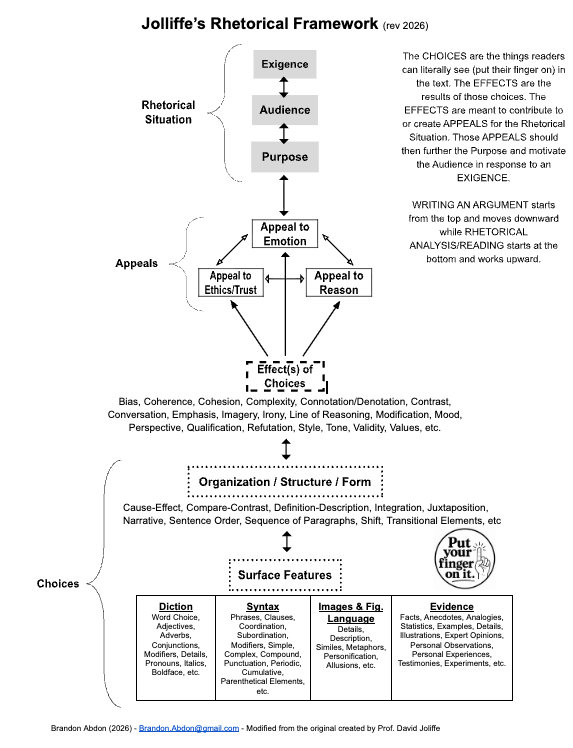 Jolliffe's diagram organizes rhetorical thinking into interconnected levels:
These categories are interconnected rather than independent.
The rhetorical situation informs the appeals and effects a writer might seek to produce. Those desired effects, in turn, inform the concrete choices the writer makes in the actual text.
And those choices are what readers actually encounter.
Returning to tired duck metaphor, the words, sentences, and paragraphs are what readers see above the water. The rhetorical relationships that give those features their purpose are the activity beneath the surface.
The framework helps students investigate that activity. It also provides a useful distinction between two related instructional processes:
Neither process is entirely linear, but these directions provide useful starting points for instruction to help students build understanding.
When students analyze an argument, they must begin with something they can actually observe. A particular word. A sentence. A statistic. An anecdote. A comparison. A structural shift. These are concrete choices. Students can literally put their fingers on them.
Consider a writer arguing that students need longer lunch periods; they write, "Eight hundred students. Twenty-two minutes. One cafeteria."
Students might identify the short sentences (or fragments… whatever), numerical evidence, and repetition of the compressed structure.
But identification is only the beginning.
What do those choices accomplish?
The compressed sentences might emphasize the disparity between the number of students and the time available to serve them. The numerical evidence may mean to help a reader understand the scale and scope of the problem in a way that a phrase like “a bunch of students” could not. It makes an otherwise abstract scheduling problem measurable. The accumulation of details across all of the short sentences might create a sense of urgency.
These are potential effects the reader is recognizing. Those effects could contribute to an appeal to reason by demonstrating a logistical problem, while also encouraging readers to recognize the human consequences of the current schedule so that they become more emotionally invested in the problem. Ultimately, the choices might help persuade school administrators to reconsider the lunch period.
Notice the movement in the chart below:
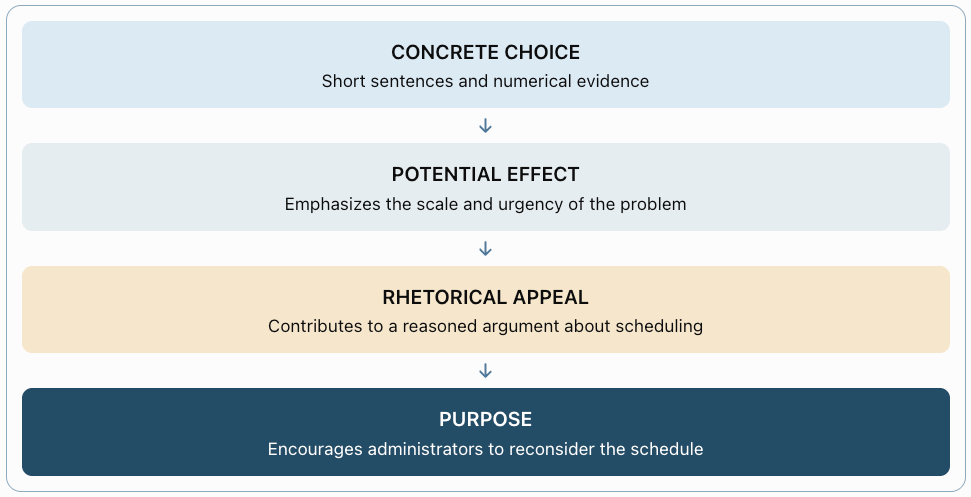
The crucial intellectual move occurs between the first and second levels where student readers must explain how a concrete choice produces an abstract effect. This is why statements such as "The writer uses statistics to appeal to logos" are insufficient. They leap from a device to an appeal without explaining how the choice actually works.
And an effect is never automatic. A statistic does not inherently create a logical appeal, just as an anecdote does not inherently create an emotional one. The effect depends on the immediate textual context, the audience, and the rhetorical situation.
Rhetorical analysis requires students to explain relationships, not simply identify features.
Now reverse the process. When composing an argument, students should begin by considering their rhetorical situation:
Once students establish these conditions, they can consider the appeals and effects that would help them accomplish their purpose.
Only then should they select the concrete choices that might produce those effects.
For example, a student writing to school administrators about lunch schedules might determine that the audience needs to recognize both the seriousness of the problem and the practicality of a proposed solution.
That determination should influence the student's choices about evidence, organization, diction, and structure. So, perhaps the argument opens with an anecdote illustrating the consequences of a shortened lunch period, transitions into scheduling data, acknowledges concerns about instructional time, and concludes with a workable proposal.
Each choice has a job.
This approach also changes how we teach revision.
Instead of simply telling students to add more evidence or improve their transitions, we can ask what their audience still needs and what effect their current choices are—or are not—producing.
Students can then revise their writing with greater purpose.
Returning to our metaphor: the duck isn't paddling randomly. Its movements are taking it somewhere.
For AP English Language and Composition teachers, the framework provides a way to connect skills that students frequently perceive as separate. Rhetorical analysis asks students to explain the choices another writer makes. Argumentation and synthesis require students to make purposeful choices themselves.
The College Board's Course and Exam Description (CED) organizes reading and writing skills into the big ideas of rhetorical situations, claims and evidence, reasoning and organization, and style. These categories reinforce the relationship between understanding another writer's decisions and making one's own.
Jolliffe's framework can make those relationships visible during instruction.
A lesson on evidence, for example, need not focus exclusively on identifying and analyzing evidence in a mentor text. Students can examine how evidence functions, determine the effects it produces, and then apply that understanding to their own arguments.
Likewise, a lesson on organization can move from analyzing why a writer introduces a counterargument at a particular moment to helping students determine where a counterargument would be most effective in their own writing.
The framework also helps teachers scaffold instruction without reducing rhetorical analysis to a formula. Students can begin with concrete observations and gradually develop the ability to explain increasingly complex relationships among choices, effects, appeals, and purposes. As their understanding develops, they can move more fluidly throughout the framework rather than following a rigid sequence.
Perhaps the most important instructional implication is transfer. Students should not learn rhetorical analysis merely to write rhetorical analysis essays. Nor should they learn argumentation solely to perform well on a timed AP exam.
Just as ducks don’t learn to swim for the fun of it.
They (students, not ducks) should develop rhetorical knowledge they can recognize, adapt, and apply in unfamiliar situations. That’s the goal of any composition course and the intent behind the AP Lang and Comp exam, too.
Yancey, Robertson, and Taczak explore this challenge in their influential Writing across Contexts (2014), examining how conceptual knowledge and reflective practice can help students repurpose writing knowledge in new settings. Jolliffe's earlier attention to discourse and interdiscursivity provides a useful connection: writing changes across communities and contexts, so students need more than a collection of supposedly universal writing rules.
They need to understand how to make rhetorical decisions and why others do the same.
A student who recognizes how an anecdote humanizes an abstract problem should be able to consider using that technique in a research paper, professional email, or public presentation. But that student must also recognize that the same anecdote may not produce the same effect for every audience.
Transfer is not simply repeating a strategy. It is adapting rhetorical knowledge to a new situation.
Teachers can encourage this process by asking students to reflect on what they learned about rhetorical choices and where else that knowledge might apply. The ultimate question becomes: How can I use what I learned from analyzing this writer's decisions to make better decisions in my own writing?
Jolliffe's Rhetorical Framework is more than a graphic organizer for teaching rhetorical appeals or identifying devices. It offers a model for understanding writing as purposeful decision-making.
Students learn to recognize concrete choices, investigate their abstract effects, connect those effects to rhetorical purposes, and apply that knowledge when composing their own arguments.
 For AP English Language teachers, this creates a bridge between rhetorical analysis and argumentation while supporting the larger goal of transferring rhetorical skills beyond the classroom.
And that brings us back to the duck: Students may initially see only the finished argument gliding across the page. Our job is to help them recognize the decisions and relationships operating beneath the surface.
Because understanding rhetoric means knowing not only what the duck looks like on the surface, but what it’s doing, how it’s doing that, and why it's working so hard underneath.
Bitzer, Lloyd F. "The Rhetorical Situation." Philosophy & Rhetoric, vol. 1, no. 1, 1968, pp. 1–14.
College Board. AP English Language and Composition Course and Exam Description. College Board, 2024.
Jolliffe, David A. "Discourse, Interdiscursivity, and Composition Instruction." Reconceiving Writing, Rethinking Writing Instruction, edited by Joseph Petraglia, Lawrence Erlbaum Associates, 1995, pp. 197–216.
Yancey, Kathleen Blake, Liane Robertson, and Kara Taczak. Writing across Contexts: Transfer, Composition, and Sites of Writing. Utah State University Press, 2014.
.png)
1 min read
Dr. David Jolliffe walked through the origins of his widely shared rhetorical framework, how he teaches it today, and why every rhetorical analysis...

1 min read
Rhetoric really is everything, everywhere, and all at once since every act of communication is spinning in a multiverse of contexts that all shape...

1 min read
In this lesson, students analyze the rhetorical situation surrounding viral social media challenges. Students will explore how these digital trends...

1 min read
In AP English Language and Composition, we ask students to enter an ongoing conversation, craft an argument, and make deliberate rhetorical choices....

1 min read
When scoring AP Lang rhetorical analysis essays, I typically see one common problem: students select good evidence, but they struggle to develop...

1 min read
Before students begin writing full rhetorical analysis essays, they need to understand the kinds of texts they will encounter on the AP Language and...

1 min read
You’ve taught rhetorical devices. You’ve practiced essays. But somehow, when it matters the most, students still struggle to connect the two. At this...

1 min read
Need extra support teaching AP® English Language and Composition? We’ve got you covered! Join our co-authors, Timm Freitas and Lauren...

1 min read
This resource will introduce students to each element of the rhetorical situation as it relates to a complex text, “Letter from a Birmingham Jail” by...

1 min read
Lesson Overview This assignment is designed to help students think critically about how we use rhetoric in everyday communication—specifically...

1 min read
While we want argument and rhetoric to develop logically and follow a line of reasoning, we also must recognize that sometimes what others see as...

1 min read
{% video_player "embed_player" overrideable=False, type='hsvideo2', hide_playlist=True, viral_sharing=False, embed_button=False, autoplay=False,...