


 View Cart
1 min read
Corequisite Support—Scaffolding with a Nudge
We’ve all been there, halfway through an amazingly planned (and executed!) lesson on the chain rule when everything comes grinding to a halt—not...

4 min read

Any distance runner will tell you that preparation for a longer run like a 10k or marathon incorporates not only distance training, but sprints as well. Athletes in general attest to the power of high-intensity interval training (HIIT). In our professional lives, we as educators often aim to set aside time for intense, focused grading and lesson planning. This same energy, when brought to the classroom, can greatly benefit student achievement.
One specific way of bringing this intensity to the classroom is through an activity called speed sheets. As the name implies, speed is the focus. Speed sheets take on many forms and variations, but the general objective is for students to do as much high-intensity math as they can in a brief window of time. Students are provided many problems and asked to answer as many of them as they can, independently and silently, in a concentrated burst.

One important note: the goal is for high-intensity (speed), not for high-rigor. Save the challenging brain-stretchers for other parts of the class.
Two examples of speed sheets are shown below; the left is for an Algebra II course, and the right for a Calculus course.
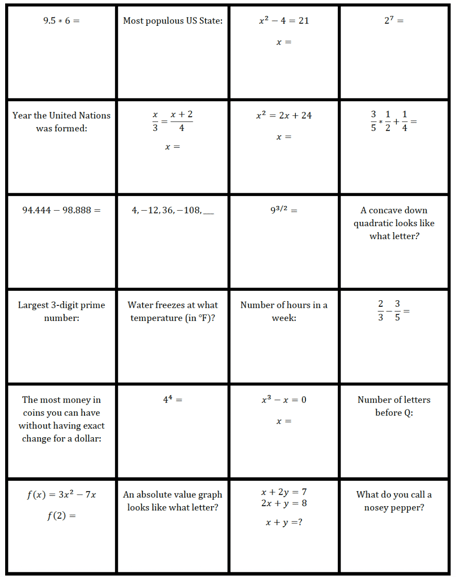
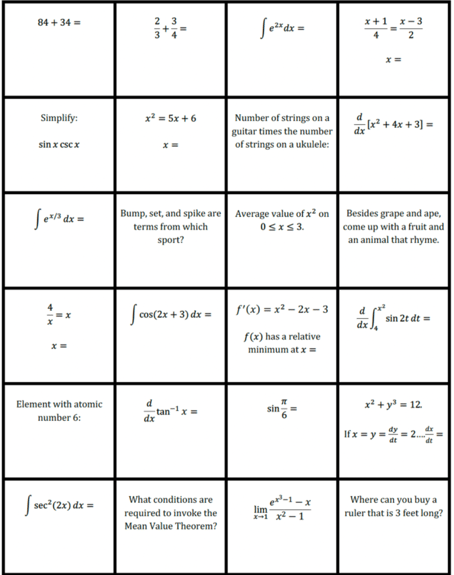
Who among us hasn’t felt frustrated when a student hits a wall halfway through a lesson, not because of the content, but because they’ve forgotten the prerequisite material? It’s the math version of wearing the wrong shoes and tripping up halfway through the race, the classroom version of an own goal.
Speed sheets are not another heavy task or high-stakes hurdle for students. They are a whiff of fresh air in the math classroom—quick bursts of energy full of quick, confidence-building wins. They facilitate the strengthening of procedure and arithmetic skills while seamlessly promoting the recall of previous content.
So, grab a timer, sprinkle in some random trivia and a "dad joke" at the bottom of the page, and let your students loose. However you use it, keep it fast, keep it light, and keep it fun. There is nothing quite like the look on a student's face when they realize they’ve finally run out of fingers to count their own progress.
Ready? Set. Sprint.

Hooman Behzadpour has taught just outside of Newark, New Jersey, since 2012, when he joined Teach For America. In his 10+ years in the classroom, he found that destructive socio-economic forces can be overcome and that success can be found in any classroom. Hooman has experience working in a variety of courses, settings, and populations. In addition to his work at a public Title 1 school serving students of underserved backgrounds, Hooman also has years of experience teaching at the university level, where he teaches a Calculus 2 course; in a private all-girls school, where he has virtually taught AP® Calculus BC; with middle school students as part of an enrichment program for students with a passion for math; with the National Math and Science Initiative (NMSI) as an AP Calculus Coach for both students and teachers; and with College Board®, as an AP Daily Instructor and as an AP Reader for both AP Calculus AB and BC.

1 min read
We’ve all been there, halfway through an amazingly planned (and executed!) lesson on the chain rule when everything comes grinding to a halt—not...

1 min read
In today’s advanced math classrooms, rigor is accessed through multiple representations. Join this dynamic edWebinar designed for AP and Honors math...

1 min read
AP Statistics can feel abstract for students—formulas, distributions, and probability rules can easily become a maze of procedures. But when data is...

1 min read
National Dropout Prevention Center’s evaluation of Measuring Up reveals students experienced substantial academic progress

1 min read
For fluent readers, reading is like having a movie play in their minds. But for struggling readers, they see pages and pages of text. Stopping to...

1 min read
Here’s my one caveat, if you’re bothered by a lot and expect quiet student perfection, this might not be the classroom management plan for you. But...

1 min read
With so much heated debate over the concept of teaching to the test, it almost seems counterintuitive to ask teachers to assess their students even...

1 min read
In my last post, I shared the success stories of two of my multilingual learners. I told you I used strategies, but I didn’t share which ones.

1 min read
Every educator knows the look: a student who has put in the work, suddenly shutting down the moment a test appears. High-stakes assessments can...

1 min read
As winter break approaches, classrooms across the country buzz with excitement—and a fair amount of distraction. December is a notoriously tricky...

1 min read
Walk into a middle school classroom during a lively literature circle and you’ll hear questions, laughter, debate, and—most important—learners...

1 min read
The start of a new year always a wonderful opportunity to introduce students to effective, research-backed methods for studying more effectively....