Skip to the main content
Perfection Learning

AP English

Help ALL your students achieve AP success with our coursebooks designed by leading experts.

AP & Honors Science

Guide students through real-world application of science concepts with Wiley’s advanced programs.

AP Social Studies

Discover a variety of accessible yet rigorous programs designed to align with AP social studies courses.

AP Computer Science

Prepare students for success on the AP Computer Science A exam.

AP & Honors Mathematics

Explore Wiley titles to support both AP and Honors mathematics instruction.

Literacy Skills & Intensive Reading

Connections: Reading – Grades 6–12

Empower student success with a proven intensive reading program that develops strong reading skills in striving readers.

Drama, Speech & Debate

Basic Drama Projects 10th Edition

Build students’ confidence and competence with comprehensive, project-based theatre instruction.

Literature

Connections: Literature

Support learners as they study dynamic, relevant texts and bring the richness of diverse voices to students through literature.

Middle School Preview | Shop
High School Preview | Shop
 

Literature & Thought

Develop critical thinking, reading, and writing across literacy themes, genres, historical eras, and current events.

Language Arts

Vocabu-Lit® – Grades 6–12

Help students build word power using high-quality contemporary and classic literature, nonfiction, essays, and more.


Connections: Writing & Language

Help students develop grammar, usage, mechanics, vocabulary, spelling, and writing and editing skills.

Reading/English Language Arts

Measuring Up to the English Language Arts Standards

Incorporate standards-driven teaching strategies to complement your ELA curriculum.

English Language Learners

Measuring Up for English Language Learners

Incorporate research-based best practices for ELLs with an approach that includes a focus on language acquisition strategies.

Mathematics

Measuring Up to the Mathematics Standards

Incorporate standards-driven teaching strategies to complement your mathematics curriculum.

Foundations

Measuring Up Foundations

Help students master foundational math skills that are critical for students to find academic success.

Reading Preview | Shop
Mathematics Preview | Shop

Science

Measuring Up to the Next Generation Science Standards

Give students comprehensive NGSS coverage while targeting instruction and providing rigorous standards practice.

Assessment

Measuring Up Live

Deliver innovative assessment and practice technology designed to offer data-driven instructional support.

World Languages

Social Studies

Science

Turtleback

Reinforced bindings of classroom novels and nonfiction for maximum durability with a lifetime guarantee.

SAT Prep

SAT Prep

Financial Literacy

Introduction to Personal Finance

Culinary Arts

Professional Cooking

Professional Baking

Welcome.

For a better website experience, please confirm you are in:

3 min read

Analyzing Rhetorical Analysis FRQs by Medium & Genre

Analyzing Rhetorical Analysis FRQs by Medium & Genre

Before students begin writing full rhetorical analysis essays, they need to understand the kinds of texts they will encounter on the AP Language and Composition Exam. This lesson introduces students to the rhetorical situation by having them closely examine actual AP prompts (with the passages removed). This activity builds students’ critical thinking, inference skills, and familiarity with nonfiction genres, allowing them to better anticipate the rhetorical choices authors make.

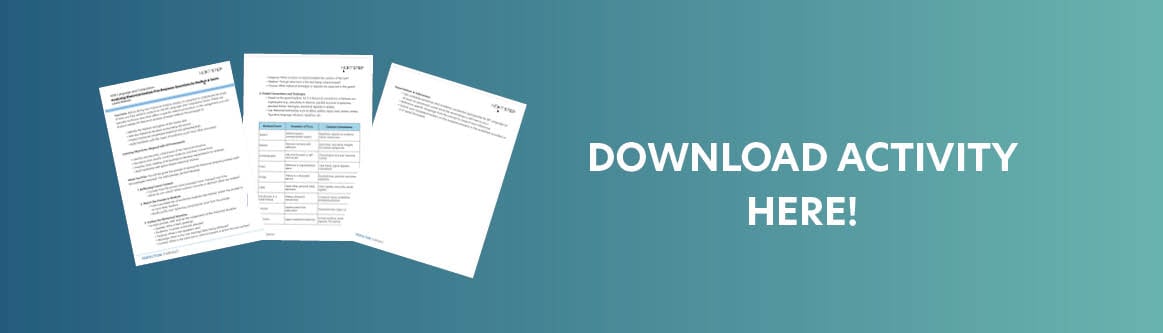
DownloadActivityButton_IntroToRhetAnalysisMediumExploration_LaurenPeterson

Big Ideas:

  • Every text is written within a rhetorical situation—a set of circumstances, needs, and purposes that shape the content and style of the message.
  • Recognizing genre conventions helps readers predict what strategies and appeals a writer may use.
  • Understanding the prompt is a key step in effective rhetorical analysis.

What Students Will Do:

  • Analyze several real AP rhetorical analysis prompts (passages removed).
  • Infer and outline the rhetorical situation: speaker, audience, purpose, message, context, exigence, medium.
  • Predict rhetorical conventions and strategies based on the genre/medium.
  • Justify their reasoning using specific textual clues from the prompt.

Learning Objectives:

By the end of this lesson, students will be able to:

  • Identify and describe components of the rhetorical situation using AP-style prompts.
  • Recognize common nonfiction genres and their rhetorical conventions.
  • Use contextual clues to make informed predictions about rhetorical strategies.
  • Use academic vocabulary related to rhetoric (e.g., ethos, tone, diction, repetition).

Before the Lesson

  • Collect a set of real AP rhetorical analysis prompts (with passages removed).
  • Print or post the worksheet or digital document for students.
  • Provide links to released AP rhetorical analysis prompts for students to review.
  • Draft or locate a model example of a completed rhetorical situation analysis for one prompt.
  • Prepare a glossary or mini anchor chart of rhetorical terms students should use (e.g., ethos, pathos, diction, tone).
  • Create a list of questions prompting to scaffold rhetorical situation inferences (e.g., "Who would be likely to deliver this message?" "What seems to be the speaker’s goal?").
  • Ensure students are familiar with components of the rhetorical situation (context, exigence, speaker, audience, purpose, message), basic rhetorical appeals and strategies, and common nonfiction genres (speech, memoir, editorial, etc.)
  • Plan a quick mini-lesson or review activity if these concepts are new or need reinforcement.

Materials and Resources

What to Do: 


Step 1: Introduce Purpose (5 minutes)

  • Begin by asking: “What do you think makes a text effective in achieving its purpose?”
  • Connect discussion to the concept of the rhetorical situation—that texts are written with a speaker, for an audience, with a purpose, in a specific context.
  • Explain: Today, we’re working backwards from AP prompts to infer what kind of nonfiction text might be behind them.

Step 2: Review Rhetorical Situation Elements (5–10 minutes)

  • Review or introduce the components: Speaker, Audience, Purpose, Message, Context, Exigence, Medium
  • Display an anchor chart or slide for reference.
  • Briefly review common nonfiction genres (speech, editorial, memoir, etc.).
  • If needed, review a few rhetorical strategies/appeals (ethos, pathos, logos, tone, etc.)

Step 3: Model the Process (5–7 minutes)

  • Use one AP prompt as a class model.
  • Show how to:
    • Use clues from the prompt to guess the genre/medium.
    • Infer the rhetorical situation.
    • Predict rhetorical strategies based on the medium.
  • Think aloud: "This prompt mentions a historical event and a public audience, so it’s likely a speech. I’d expect a formal tone, appeals to values, maybe repetition...”

Step 4: Student Practice (20–25 minutes)

  • Distribute 2–3 different AP prompts (or one at a time).
  • Students complete the worksheet for each:
    1. Match to a nonfiction medium
    2. Infer the rhetorical situation
    3. Predict rhetorical strategies/conventions
    4. Justify their thinking using language from the prompt
  • Optional differentiation: 

    • Let advanced students choose from a larger bank of prompts.
    • Offer scaffolding questions or sentence frames to students who need them.

Step 5: Share & Discuss (5–10 minutes)

  • Have students share responses in pairs or groups:
    • Do you agree with the genre/medium?
    • What differences do you notice in your rhetorical situation of breakdowns?
  • Facilitate a brief class discussion:
    • What clues helped you figure out the genre?
    • Which parts of the rhetorical situation were hardest to infer?

Step 6: Reflect & Wrap-Up (5 minutes)

  • Ask students to respond to one of the following:
    • “What surprised you about analyzing the prompt without the passage?”
    • “How can this help you when you actually write a rhetorical analysis essay?”
  • Optionally collect reflections or use them as an exit ticket.

After Class (Follow-Up Options)

  • Review worksheets for accuracy and depth of reasoning.
  • Use insights to form small groups for future practice.
  • As an extension, have students write a short rhetorical analysis paragraph based on one of the prompts once they’ve seen the original passage.

ProductPageBlogButtons (2)

Rhetorical Analysis: Letter from a Birmingham Jail

Rhetorical Analysis: Letter from a Birmingham Jail

This resource will introduce students to each element of the rhetorical situation as it relates to a complex text, “Letter from a Birmingham Jail” by...

Read More
Situation and Context in AP English Language and Composition

Situation and Context in AP English Language and Composition

Rhetoric really is everything, everywhere, and all at once since every act of communication is spinning in a multiverse of contexts that all shape...

Read More
Creating Text Messages to Reflect Rhetorical Situation Activity

Creating Text Messages to Reflect Rhetorical Situation Activity

Lesson Overview This assignment is designed to help students think critically about how we use rhetoric in everyday communication—specifically...

Read More
Teaching Students to Think Rhetorically About Statistics

Teaching Students to Think Rhetorically About Statistics

In AP English Language and Composition, we ask students to enter an ongoing conversation, craft an argument, and make deliberate rhetorical choices....

Read More
AP® Lang: Word of the Year

AP® Lang: Word of the Year

It's almost the end of the school year! With the exam behind you and your students, take a moment in class to reflect on this past year (while giving...

Read More
AP® Lang: Understanding a Line of Reasoning

AP® Lang: Understanding a Line of Reasoning

Guide students through an engaging activity that stresses the importance of the thesis & topic sentences to structure the line of reasoning. Students...

Read More
A Rhetoric of Empathy in AP Lang

A Rhetoric of Empathy in AP Lang

While we want argument and rhetoric to develop logically and follow a line of reasoning, we also must recognize that sometimes what others see as...

Read More
Rhetoric Meets Remedy: Visual Rhetoric in a Collaborative Classroom

Rhetoric Meets Remedy: Visual Rhetoric in a Collaborative Classroom

In the previous blog posts of this series, I shared how I’ve transformed my English classroom into a collaborative space where students aren’t just...

Read More
Six Word Memoir Activity

Six Word Memoir Activity

In this creative and reflective assignment, you’ll explore the art of powerful storytelling through just six words. You’ll examine examples of 6-word...

Read More
AP® Language: Exploring Contemporary Issues

AP® Language: Exploring Contemporary Issues

In this lesson, students are asked to consider how they are situated within the world around them–locally, nationally, and globally. Students will...

Read More
From Summary to Insight: Pushing AP English Students Toward Sophisticated Commentary

From Summary to Insight: Pushing AP English Students Toward Sophisticated Commentary

One of the most persistent challenges in AP® English classrooms isn’t getting students to write—it’s getting them to move beyond summary.

Read More
AP Literature: Character Layers Analysis Activity

AP Literature: Character Layers Analysis Activity

We are all constantly practicing the skill of character analysis. I remind my often insecure students of this fact before we dive into a difficult...

Read More