


 View Cart
1 min read
Before You Teach History, Teach Students How Historians Think
Every August, AP® History teachers face the same challenge. We spend the first day introducing the course, reviewing the syllabus, discussing summer...

5 min read

In the Course and Exam Descriptions (CED), College Board AP History courses are designed for students to “develop and use the same skills, practices, and methods employed by historians,” those skills being “analyzing primary and secondary sources; developing historical arguments; making historical connections; and utilizing reasoning about comparison, causation, and continuity and change over time.”
The most advanced part of the AP History exam, where students are expected to demonstrate their mastery of these skills, is the Document-Based Question (DBQ). The DBQ presents students with seven primary source documents and tests the six AP Historical Thinking Skills outlined at the beginning of each CED.

This task seems daunting to students and is challenging to teach. Teachers often wait to introduce the DBQ in the second semester, even though the skills are developed earlier. Here is one classroom-tested method to introduce scaffolded DBQs early in the first semester, which allows students to practice earlier and therefore develop and master these skills in the second semester.
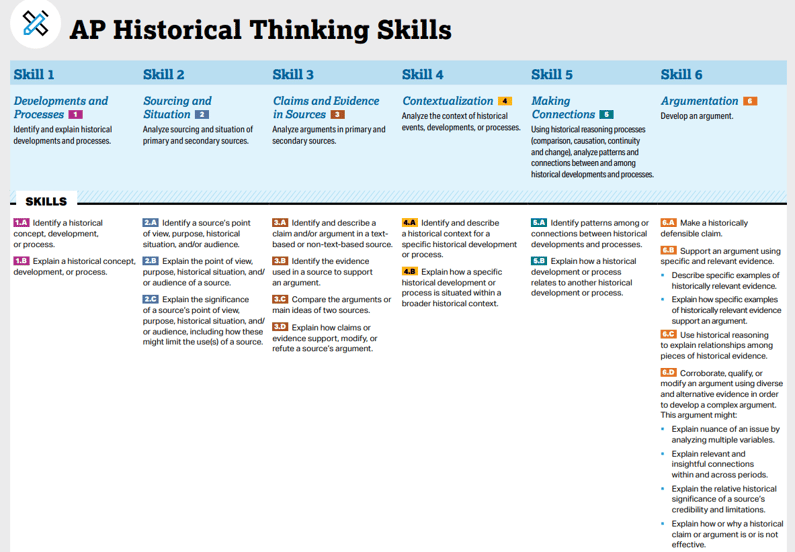
AP Historical Thinking Skills: College Board®
Helpfully, the CED breaks down the Historical Thinking Skills into parts, which can be introduced gradually, both in modified DBQs and other assessments in class. Rather like laying the solid foundations of a house, DBQ skills can be built layer upon layer.
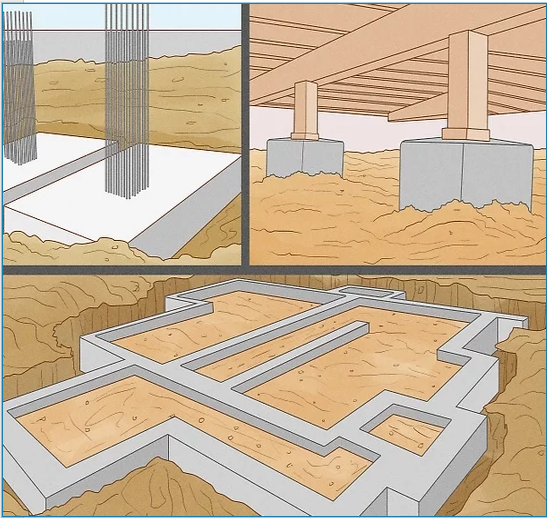
The foundational level of a DBQ is structure, followed by Skills 6A and 4A and 4B: claim/thesis and context.
There are various graphic organizers that are helpful in understanding the structure of a DBQ and LEQ, and my own AP History students find this one particularly helpful.
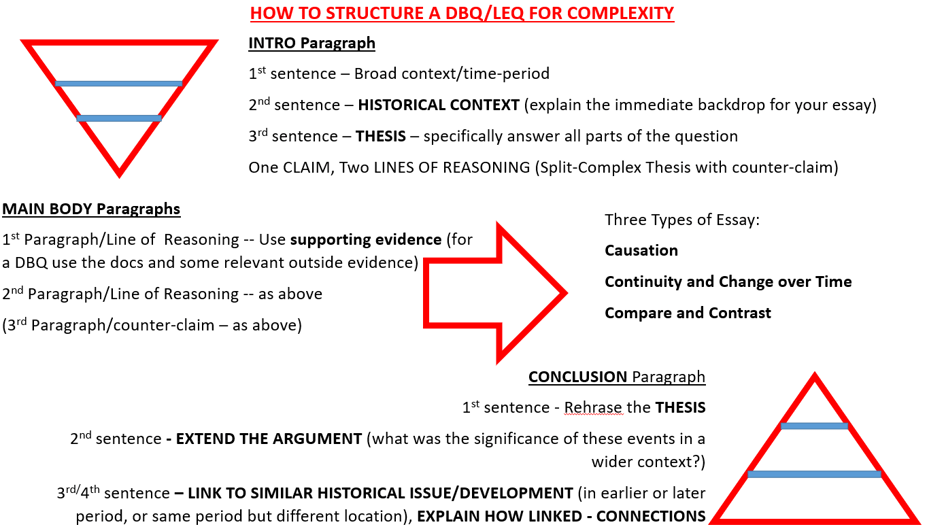
LEQs follow a similar structure, so hand out this document and the College Board LEQ rubric before the first LEQ. From there, give students feedback in their thesis, covering both the claim and line of reasoning, and then on their context sentences that lead into it. That sequence lays a solid foundation for a successful DBQ.
The CED lists the foundational skill of argumentation as “making a historically defensible claim.” Most students will find this familiar, since it mirrors the TEA method of writing. Having them practice, plan, and write out thesis statements containing a claim and two lines of reasoning—these will become their first and second body paragraphs. Each line of reasoning supplies the topic sentence that opens a paragraph (the T), and the evidence and analysis follow (The E and the A). In a DBQ, that evidence is the documents, and the analysis is what students say about them.
Then, for Contextualization, the students can practice adding several broad sentences narrowing down to the question the DBQ (or practice LEQ) asks, ensuring the context is relevant to the prompt.
Once students have had some introduction to SAQs and the presentation of evidence— especially in Explain tasks—and once sourcing has been introduced through primary source work in class, along with the HAPP(Y)/HIPP(Y)/SOAP method of document analysis, they are ready for their first ADAPTED DBQ.
You might reduce the number of documents to five and use an adapted rubric that either omits complexity or adds a +1 curve for the D2 Demonstrating Complexity point. You could also shorten the documents themselves.
Extending the time beyond 60 minutes, perhaps to as much as two hours, gives students room to plan thoroughly, examine each document carefully, and write and revise sections. Another option is to let them keep a copy of the DBQ rubric in front of them, and/or the DBQ/LEQ scaffolding document, as a reminder of a proven structure and the rubric points they need to hit.
In my experience, the key to this first DBQ is feedback, so teachers should plan a significant amount of time to deliver group and—if class sizes allow—individual feedback. Allotting more time for feedback early on will pay dividends later, both in students’ skill development and in the teacher’s grading time.
I also suggest using a previously administered College Board DBQ for the first few DBQs. Students see the exact format they will face on the exam, and you can share the official Scoring Guidelines and even student sample essays as additional feedback.
(For an example of a suggested early DBQ, Units 2-3, to modify, see the attached 2018 AP European History DBQ on the 30 Years’ War.)
The improvement between your students’ first DBQ and second DBQ, especially if you’ve been able to give personalized feedback, should be significant and will provide them with encouragement to press on in the development of the Historical Thinking Skills. Stage two then is to refine issues with thesis and context, and to move into using the documents effectively as evidence, further developing their initial sourcing skills—skills 2B and 3C.
To move from Describe to Explain, 2A to 2B:
… and to move from identifying arguments in documents to comparing arguments, including grouping them effectively in their main body paragraphs. To move from 3B to 3C:
This stage is the development of the key evidence or layers or rooms of a building. Based on the solid foundation of a strong thesis, the main evidence from the documents and arguments from the documents can be firmly placed.
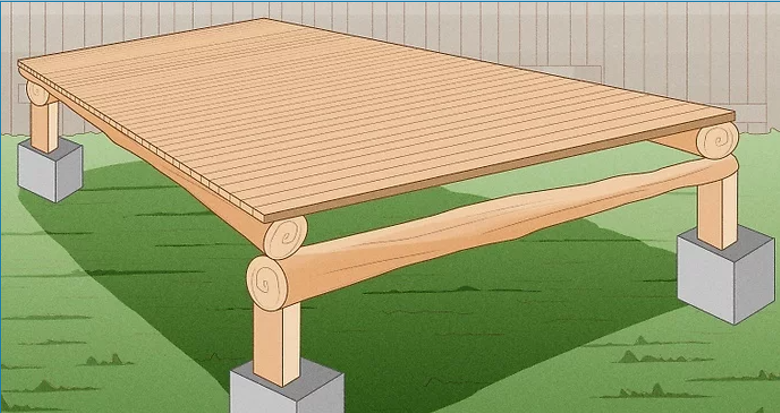
For a modified second DBQ, the changes might include reducing the time limit to 90 minutes, introducing all seven documents, and using the documents at full length. This DBQ should also score sourcing attempts more narrowly, closer to exam standards, compared to their first DBQ, where some generosity was appropriate. If your students seem ready, you could also introduce one method of demonstrating a complex understanding. I’d suggest the “explain both” counterargument in a final body paragraph, paired with a split-complex thesis. If they are not ready yet, this skill can wait until after the mid-point of the first semester.
The level of modification will depend on how your students are progressing. Around the mid-point of the first semester, it’s worth telling them the training wheels will be off by the end of the semester. Every DBQ in the second semester will match the AP exam format—written in 60 minutes and scored to exam standards. Knowing this will give students additional incentive to focus on their skill development.
(For an example worth adapting at the midpoint of the first semester, around Units 3–5, see the attached 2024 APUSH DBQ on slavery, 1783–1840.)
The final stage of scaffolding skill development in first semester DBQs is to introduce in the D2 point, demonstrating a complex understanding. You might reassure students by scoring it generously the first time it’s introduced.
There are several ways to approach this, as the additions to the DBQ and LEQ rubric examples illustrated last year. One of the six Historical Thinking Skills that other question regularly test is Connections, skills 5A and 5B:
Aside from explaining a counterargument, this is a path to complexity your students will likely find familiar by now, since you’ve tackled a third or more of your class. They should be comfortable identifying historical connections and similarities that reach back to earlier units, themes, and places, and perhaps even forward to events today.
Having spent much of your first semester, and Stages One and Two of your DBQ sequence, focused on the skill of sourcing is another advantage: sourcing additional documents, four of them at this stage, is itself a path to demonstrating a complex understanding. Historical Thinking Skills 2C and 3D are relevant here:
Finally, nuance appears as one of the bullet points under skill 6D and can be introduced through classroom activities as you approach the middle of your AP History course. One basic way to introduce nuance, especially in the context of sourcing documents is in the source line itself. By the 1700 and 1800s in our history courses terms and “isms” such as liberalism, conservatism, republicanism, and even nationalism or nationality are starting to be used to define a document’s author. Introducing the nuanced idea that not all liberals or conservatives or Haitians or Chinese or Americans think/act the same can be a basic way to introduce skill 6D:
(for an example of an end of mid-first semester DBQ, units 5–6, to modify, see the 2023 AP World Collapse of Qing dynasty DBQ—attached)
If you are able to scaffold an introduction to the DBQ so that students have been able to practice and develop their skills writing several before the end of the first semester, then hopefully they have come close to completing all the tasks required—akin to completing the building with a solid roof.

Students who have worked through most of these steps can now tackle complete DBQs in 60 minutes in the second semester. If you do a paper-and-pencil first semester, or let students write DBQs at home, the second semester is the time to move to typed, in-class DBQs as they hone their skills for the exam. It’s also a good idea to give a variety of types of DBQs at this stage, both in the skill each prompt asks for (“extent to which” versus other phrasings) and in the document types, including DBQs with a map, chart, or another non-text source that is not always a painting or photograph.
I hope these strategies offer you some ideas for scaffolding a first semester introduction to DBQs, giving your students more time to practice, and more confidence for their final DBQ in May.

1 min read
Every August, AP® History teachers face the same challenge. We spend the first day introducing the course, reviewing the syllabus, discussing summer...

1 min read
Unlock the power of historical thinking and writing as you elevate complexity and engagement in AP History classrooms. Presented by experienced AP...

1 min read
For AP history teachers, curriculum changes often bring a mixture of curiosity and concern. Fortunately, the College Board® updates to the AP...

1 min read
Every August, I tell my students to download the AP History Course and Exam Description (CED). Almost every one of them does. Then, like many AP...

1 min read
This interactive webinar focuses on scaffolded approaches to the finishing touches necessary for higher-level success on the LEQ and DBQ portions of...

1 min read
Join AP experts Brandon Abdon, Colin Baker, and Bob Topping to discover scaffolded approaches to teaching the APUSH, AP Euro, and AP World History...

1 min read
Experienced AP World History teacher Dave Drzonek and AP World History Exam table leader Charlie Hart discuss what students did well and what they...

1 min read
When most teachers—and students—think about a DBQ, they think about writing. And yes, writing the full essay is essential. But if that’s all we ever...
1 min read
Primary sources provide students with a personal window into the past, enabling them to view history as human stories rather than a list of facts....

1 min read
AP Social Studies courses ask students to do something uniquely difficult: think with big,universalideas while working with very specific...

1 min read
From a practical point of view, argumentation is at the heart of the free response section of the AP exam. This can be particularly difficult with...

1 min read
In this short video, veteran AP® World History teacher Dave Drzonek walks through a first-week lesson that turns note-taking into a structured...