


 View Cart
1 min read
Student-Generated Questions: How to Teach 3 Levels of Questioning
There is no shortage of professional development on teaching educators how to write questions. We add them to our lesson plans, we spin manual or...

3 min read

As artificial intelligence becomes increasingly accessible, many teachers are asking the same question: How do we teach students to think for themselves when technology can generate ideas instantly? The answer isn't to avoid AI. Instead, it's to teach students the difference between producing information and generating insight. While AI can summarize, explain, and organize information, it cannot replace a student's unique perspective, experiences, values, and reasoning. This lesson helps students recognize that their most valuable contribution to any piece of writing is not the information they find, but the thinking they do with that information.
 Learning Objectives
Students will:

Choose a High-Interest Prompt
|
Information |
Insight |
|
|
Display three statements:
Ask students:
Which statement is most interesting? Why?
Guide students to recognize that stronger ideas often move beyond facts and into interpretation.
Introduce the key question: "What can humans contribute that AI cannot?"
Explain: Information answers questions. Insight creates new questions, interpretations, or connections. Use the AI-generated response as an example. Read it aloud. Ask:
Students will likely identify that the response is accurate but not particularly memorable or unique. Explain: AI can generate information quickly. Writers create value when they move beyond information and develop insight.
Add student observations to the anchor chart.
Divide students into pairs or small groups. Provide each group with a common statement. Examples:
Students must climb the "Idea Ladder."
Reading allows people to experience lives they would never encounter otherwise.
Books function as empathy machines, helping readers understand experiences beyond their own.
Groups share their final insights with the class. Discuss which ideas feel most original and why.
Provide students with a short article or text. Ask them to identify:
Then challenge them: "What is a connection, pattern, or perspective that the author did not explicitly state?" Students discuss answers with their partners. Emphasize that original thinking often emerges from noticing connections others overlook.
Students choose a topic from the lesson. Using the "Idea Ladder" organizer, they move from:
Students then write an original claim or thesis statement. Examples:
Instead of: "Technology affects communication."
Students might write: "The convenience of digital communication has increased connection while reducing opportunities for meaningful conversation."
Encourage students to take intellectual risks and explore unique perspectives.
Ask students to respond to the following prompt: "What is something you can contribute to a piece of writing that AI cannot?" Students write independently before sharing with a partner. Possible responses:
Complete the sentence frames:
Information tells us ________________________________________________________________________________________________________.
Insight helps us ___________________________________________________________________________________________________________.
One original idea I developed today was _________________________________________________________________________________.
Provide students with an AI-generated response and a student-generated response to the same prompt. Students analyze:
Students then revise the AI-generated response by adding original thinking and personal perspective.
The future of writing is not a competition between students and AI. The future belongs to students who can think critically, make connections, ask meaningful questions, and develop original insights. Information is increasingly easy to access. Original thinking remains one of the most valuable skills students can develop. By teaching students how to move from facts to insights, teachers help them discover the one thing technology can't replicate: their unique way of seeing the world.

1 min read
There is no shortage of professional development on teaching educators how to write questions. We add them to our lesson plans, we spin manual or...

1 min read
Students often rely on summaries as a shortcut to understand literature. While summaries help review the plot, they flatten storytelling into a list...
1 min read
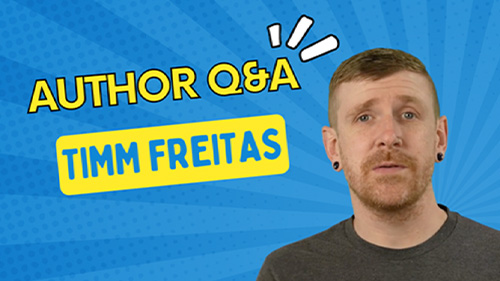
Want to learn more about author and Garden of English creator Timm Freitas? Tune into our new Author Q&A series! Learn who inspired to become a...

1 min read
In this creative and reflective assignment, you’ll explore the art of powerful storytelling through just six words. You’ll examine examples of 6-word...

1 min read
With an emphasis on close reading, analysis, and full-length essays, losing track of sentences is easy. Join Dr. Brandon Abdon, author of our AP®...

1 min read
The first days of any AP® English course are less about handing out a syllabus and more about laying a foundation: telling students what is expected...

1 min read
I never expected my application to be accepted. I was in the middle of my first year teaching AP Literature, and, at least in my mind, I am the...

1 min read
Every May, AP readers hear the same refrain: “The sophistication point is a unicorn.” But that’s not quite right. Unicorns don’t exist. The...
.jpg)
1 min read
The first weeks of an AP English course carry more weight than the calendar suggests. Some students walk in certain they belong. Others were talked...

1 min read
The AP exams end, the proctors tell students to log out, and for a brief moment, the room exhales. That one day in May has really come and gone. Then...

1 min read
“The December spiral … prevents us from seeing the slow, meaningful gains our students are actually making.”

1 min read
Join authors Dr. Brandon Abdon and Becky McFarlan to learn about how to connect learnings from the AP Lang and AP Lit courses. {% video_player...