Skip to the main content
Perfection Learning

AP English

Help ALL your students achieve AP success with our coursebooks designed by leading experts.

AP & Honors Science

Guide students through real-world application of science concepts with Wiley’s advanced programs.

AP Social Studies

Discover a variety of accessible yet rigorous programs designed to align with AP social studies courses.

AP Computer Science

Prepare students for success on the AP Computer Science A exam.

AP & Honors Mathematics

Explore Wiley titles to support both AP and Honors mathematics instruction.

Literacy Skills & Intensive Reading

Connections: Reading – Grades 6–12

Empower student success with a proven intensive reading program that develops strong reading skills in striving readers.

Drama, Speech & Debate

Basic Drama Projects 10th Edition

Build students’ confidence and competence with comprehensive, project-based theatre instruction.

Literature

Connections: Literature

Support learners as they study dynamic, relevant texts and bring the richness of diverse voices to students through literature.

Middle School Preview | Shop
High School Preview | Shop
 

Literature & Thought

Develop critical thinking, reading, and writing across literacy themes, genres, historical eras, and current events.

Language Arts

Vocabu-Lit® – Grades 6–12

Help students build word power using high-quality contemporary and classic literature, nonfiction, essays, and more.


Connections: Writing & Language

Help students develop grammar, usage, mechanics, vocabulary, spelling, and writing and editing skills.

Reading/English Language Arts

Measuring Up to the English Language Arts Standards

Incorporate standards-driven teaching strategies to complement your ELA curriculum.

English Language Learners

Measuring Up for English Language Learners

Incorporate research-based best practices for ELLs with an approach that includes a focus on language acquisition strategies.

Mathematics

Measuring Up to the Mathematics Standards

Incorporate standards-driven teaching strategies to complement your mathematics curriculum.

Foundations

Measuring Up Foundations

Help students master foundational math skills that are critical for students to find academic success.

Reading Preview | Shop
Mathematics Preview | Shop

Science

Measuring Up to the Next Generation Science Standards

Give students comprehensive NGSS coverage while targeting instruction and providing rigorous standards practice.

Assessment

Measuring Up Live

Deliver innovative assessment and practice technology designed to offer data-driven instructional support.

World Languages

Social Studies

Science

Turtleback

Reinforced bindings of classroom novels and nonfiction for maximum durability with a lifetime guarantee.

SAT Prep

SAT Prep

Financial Literacy

Introduction to Personal Finance

Culinary Arts

Professional Cooking

Professional Baking

Welcome.

For a better website experience, please confirm you are in:

4 min read

Using Art to Teach Historical Thinking Skills: Introducing the 4 C's

Using Art to Teach Historical Thinking Skills: Introducing the 4 C's

One of the best days I’ve ever had in the classroom is when we look at art.

For years, I’ve woven artwork into my AP U.S. History and AP Language classes in different ways. In APUSH, these days often come at the end of a unit—as a summative reflection, where we pause and think more deeply about what we’ve just studied. In AP Lang, I tend to start units with art, using it to frame the themes and tones of different literary periods. In both cases, students respond positively—not just because they enjoy the change of pace, but because art taps into their ability to think critically, observe closely, and make connections across time.

What I’ve come to realize is that art isn’t just a teaching tool for content. It’s a powerful way to reinforce historical thinking skills. In particular, I use four central skills that I call the “4 C's”:

  • Contextualization
  • Causation
  • Comparison
  • Continuity and Change Over Time

These are the same skills emphasized in AP History rubrics and instructional frameworks. Let me show you how they come alive through visual art—and how you can easily implement them in your classroom.

Contextualization & Causation: George Bellows, Cliff Dwellers (1913)

Historical context means situating an event, person, or artwork within the broader forces of its time.

Causation is the ability to identify, analyze, and evaluate the reasons why historical events happened and the effects they produced. It asks students to distinguish between short-term and long-term causes, consider multiple contributing factors, and trace both the intended and unintended consequences of historical change.

When students study Cliff Dwellers by George Bellows, they are immersed in the noisy, crowded streets of early 20th-century urban life. Bellows was active during the Progressive Era—a time of immense immigration, industrial growth, and social reform. His paintings, especially this one, offer a vivid entry point for exploring both contextualization and causation. After observing and discussing the painting, students can dig into questions like:

Discussion Questions for Context & Causation:

  • What economic and social factors contributed to the overcrowded urban environment depicted in Cliff Dwellers?
  • How did immigration and industrialization shape the living conditions shown in the painting?
  • What were the short-term and long-term consequences of urban overcrowding for individuals and communities during this period?
  • How does Cliff Dwellers reflect the experiences and resilience of immigrant and working-class communities in early 20th-century cities?
  • What parallels can you draw between the challenges depicted in Cliff Dwellers and modern urban issues, and how have the causes and effects of urban overcrowding evolved over time?

View Cliff Dwellers here

Comparison: Gilbert Stuart vs. Jacques-Louis David

Comparison is the ability to describe, compare, and evaluate the similarities and differences among historical developments, processes, individuals, or ideas. It requires students to explain the significance of those similarities and differences within their historical context and to consider what these contrasts reveal about the broader time period.

When teaching comparison, I often use two iconic portraits of leaders painted around the same time but in radically different political contexts:

  • George Washington (Lansdowne Portrait) by Gilbert Stuart (1796)
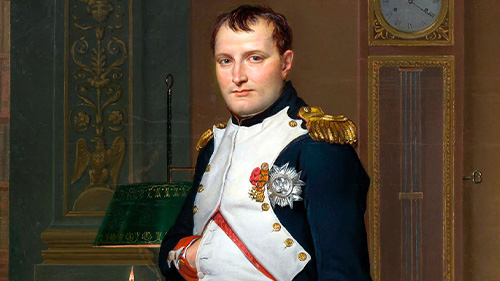
  • Napoleon in His Study at the Tuileries by Jacques-Louis David (1812)

Both portraits are loaded with symbolism—from posture to props—and open up fascinating conversations about leadership, revolution, and political identity.

Discussion Questions for Comparison:

  • How do the artists use symbolism to convey the leadership qualities of Napoleon and Washington? What do these symbols suggest about their respective leadership styles?
  • In what ways do the poses and expressions of Napoleon and Washington reflect their roles and responsibilities as leaders?
  • How do the backgrounds and objects in each painting communicate the political and cultural values of their time?
  • How do the portraits reflect the contrasting leadership contexts of their subjects: Napoleon as an emperor in post-revolutionary France and Washington as a president in the newly established United States?

View Lansdowne Portrait
View Napoleon in His Study

Continuity and Change Over Time: Thomas Cole, The Course of Empire (1833–1836)

Continuity and Change Over Time is the ability to identify and analyze patterns of stability and transformation across different periods in history. It asks students to recognize what stayed the same, what changed, and why, while connecting these patterns to larger historical processes and themes.

Thomas Cole’s five-painting series, The Course of Empire, is a masterclass in showing the rise and fall of civilizations. From untouched wilderness to imperial grandeur—and ultimately to desolation—the paintings invite students to consider the consequences of expansion, industry, and hubris.

These works are ideal for teaching continuity and change over time. They allow students to trace the moral and historical arc of empire, and to reflect on parallels in both American and global history.

Discussion Questions for Continuity and Change:

  • How does Cole’s depiction of the progression from wilderness to empire reflect broader historical patterns of continuity and change in human civilizations?
  • How does Cole’s portrayal of the natural environment evolve across the series? What does this suggest about the relationship between humans and nature over time?
  • What moral or philosophical messages might Cole be conveying about the changes that come with the growth of civilizations? Do these messages still apply to modern societies?
  • In what ways does The Course of Empire critique the idea of progress? How does this critique challenge or align with the historical context of Cole’s time, including industrialization and westward expansion?

View all five The Course of Empire paintings

Final Thoughts: A 4-Step Classroom Procedure

If you’re ready to bring this to your classroom, here’s a tried-and-true process I’ve used with success:

  1. 5 minutes – Individual Reflection:
    Students examine the artwork, note the artist’s life dates, and write down as much as they can about the historical context in which the artist lived. Prompt them to consider significant events, cultural movements, political climates, and technological advancements.
  2. 10 minutes – Small Group Discussion:
    In small groups, students share their contextual observations and compare interpretations. This opens the door to collaborative learning and deeper insight.
  3. 5 minutes – Skill Explanation:
    Introduce the historical thinking skill being emphasized that day or with that work of art(s)—Contextualization, Causation, Comparison, or Continuity and Change Over Time. Explain how the artwork(s) provide an entry point for practicing that skill.
  4. 15–20 minutes – Whole-Class Discussion:
    Use the specific guiding questions above (tailored to each image and skill) to walk through a thoughtful class discussion. Encourage evidence-based answers, cross-talk, and thematic connections.

Why This Works

Art activates historical empathy, critical thinking, and creativity. It encourages students to make meaning through evidence and helps them engage with the past in personal and powerful ways. Whether you’re closing a unit, introducing a new one, or just adding a fresh layer of depth to your instruction, using visual art to teach the 4Cs gives students tools they can apply across disciplines.

So grab a painting, give students the space to observe and discuss, and let the 4Cs guide the way.

ProductPageBlogButtons (2)ProductPageBlogButtons (3)

Working for the Finish Line (AP Histories Webinar)

Working for the Finish Line (AP Histories Webinar)

This interactive webinar focuses on scaffolded approaches to the finishing touches necessary for higher-level success on the LEQ and DBQ portions of...

Read More
Cracking the Rubrics: Demystifying AP Social Studies Scoring for Students

Cracking the Rubrics: Demystifying AP Social Studies Scoring for Students

For many students, the most intimidating part of an AP® Social Studies exam isn’t the content—it’s the rubric.

Read More
Thinking and Writing as An Historian: Accelerating Writing in the AP History Classroom

Thinking and Writing as An Historian: Accelerating Writing in the AP History Classroom

Unlock the power of historical thinking and writing as you elevate complexity and engagement in AP History classrooms. Presented by experienced AP...

Read More
Nailing the 5 and Shooting for the 6 on an AP History DBQ

Nailing the 5 and Shooting for the 6 on an AP History DBQ

Join AP experts Brandon Abdon, Colin Baker, and Bob Topping to discover scaffolded approaches to teaching the APUSH, AP Euro, and AP World History...

Read More
Beyond The Essay: Creative Ways to Use DBQs in the AP Classroom

Beyond The Essay: Creative Ways to Use DBQs in the AP Classroom

When most teachers—and students—think about a DBQ, they think about writing. And yes, writing the full essay is essential. But if that’s all we ever...

Read More
Mastering Abstract Concepts in AP Social Studies for Exam Success

Mastering Abstract Concepts in AP Social Studies for Exam Success

AP Social Studies courses ask students to do something uniquely difficult: think with big,universalideas while working with very specific...

Read More
Bringing Primary Sources to Life: Engaging Ways to Teach Documents Beyond Close Reading

Bringing Primary Sources to Life: Engaging Ways to Teach Documents Beyond Close Reading

Primary sources provide students with a personal window into the past, enabling them to view history as human stories rather than a list of facts....

Read More
AP® World History: Comparison, Continuity, and Causation

AP® World History: Comparison, Continuity, and Causation

Do your students struggle to understand the difference between Comparison, Continuity, and Causation when writing essays? Using this presentation...

Read More
Women's History Month: Gender and Disease in World History

Women's History Month: Gender and Disease in World History

In celebration of Women's History Month, explore this lesson with your students that gives them the opportunity to practice an important part of the...

Read More
Analyzing Historians' Perspectives on the Rwandan Genocide

Analyzing Historians' Perspectives on the Rwandan Genocide

The following lesson plan uses the historical thinking skills of comparative and cause and effect to analyze two historians' perspectives on the...

Read More
How to Approach the 2023 AP® World History Exam

How to Approach the 2023 AP® World History Exam

Experienced AP World History teacher Dave Drzonek and AP World History Exam table leader Charlie Hart discuss what students did well and what they...

Read More
AP Human Geography: How to Improve FRQ Responses

AP Human Geography: How to Improve FRQ Responses

This blog entry is designed to provide some hints to help your students improve their writing on the free-response section of the exam. The...

Read More