


 View Cart
1 min read
Cracking the Rubrics: Demystifying AP Social Studies Scoring for Students
For many students, the most intimidating part of an AP® Social Studies exam isn’t the content—it’s the rubric.

4 min read

Having taught AP® for 25+ years, it’s tempting, and entirely understandable, to want to not add to your workload to maintain your sanity and give your best to your students throughout an intense and fast-paced year. There’s often not enough time for all the content, never mind anything extra.
In my years working with AP teachers for the College Board’s Development Committee for AP European History, leading professional development webinars and conferences for AP Social Studies teachers for Perfection Learning, and for Virginia Tech’s European Union center, CEUTS, I’ve often encountered this feedback.

But what if there was a way to add to your students’ skills, and encourage them to buy-in to your course—perhaps more than before—resulting not only in increased exam scores but also in a reduced workload for you (at least by the second semester)?
This has been my experience as an AP teacher over the past decade after I started focusing on the skill of Connections at the start of each academic year.
Here are 5 reasons why your students (and you) benefit from starting your year with Connections.
AP History and Social Studies classes are often populated at the start of the year by students with mixed motivations. They’ve heard from peers why to take your class or not take another class. Some of this information may not be wholly accurate. Other times parents or peer pressure may influence them. On the other hand, you may get driven students who’ll be hard-working from day one. You may end up with a real mixed bag of motivations, and probably abilities, and perhaps even more students than you anticipated or feel you can give proper feedback to.
If you start your year with real-world content from your course that is relevant to them/their lives and is happening currently, you have a golden opportunity at the start of the year to engage them in a way that immediately diving into unit 1 content might not. This is especially true in the AP Histories where 1492 seems a long time ago, never mind 1200.
Not that you will stay in the present long, but just enough to show them a connection from the present to their lives and to your course - even better would be long enough for them to begin to tease out a connection themselves.
For example in AP Euro you could start with authoritarianism in Europe…
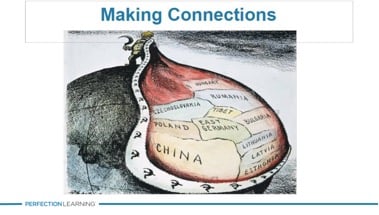
…and scaffold the time of the Czars to communism, but then ask them to go further and discuss Russia today, asking them how this relates to the course…but how also how current US policies to Russia relate to them and their world. If you were feeling especially bold on day one you could even ask them to respond for homework with a personal example, or a follow-up image that illustrates a connection to the theme of authoritarianism today. For example:
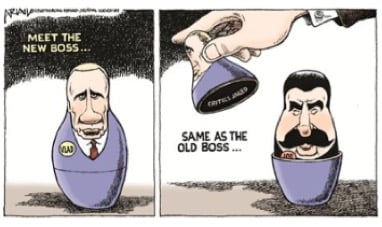
(the small caption inside the doll reads “critics jailed”)
They can tease out patterns and continuities and connections—then analyze these for validity following feedback from you (and perhaps classmates). Feedback can be in a think-pair-share environment, a larger classroom discussion, or individually from you verbally or in writing. It could also be done in a graphic format—a Venn diagram or other.
As you begin a new unit, subject or concept you can offer them these opportunities. The goal is that they begin to ditch the idea that they are passive observers, trying to find the single “right” answer to some historical question, geographic or governmental concept. But rather that they can present evidence and offer their own argument. Encourage them to be engaged and to identify patterns, themes, and concepts as they encounter new content—and connect these to previous content or to the present.
Did you know that Connections is deeply rooted in not only the AP History CEDs but all the AP Social Studies courses? And why? Because the courses are intended to give a glimpse into what professional historians, geographers, political scientists, economists, psychologists, etc. actually do. They trace developments and transfer knowledge and concepts to enhance a deeper understanding.
In developing an understanding of connections between developments, time periods, and the present, students gain a double bonus of not only obtaining a rich knowledge of the historical unit you are studying in class, but they also gain a richer understanding of the present.
Below are examples from various AP Social Studies CED highlighting the central importance the College Board places on Connections. AP Government in fact requires a project on Civic Connectionss
Not only is Connections one of the paths to demonstrating a complex understanding in the AP Histories LEQ and DBQ, but Development Committees build it into SAQ and MCQ questions. As you students practice and develop the skill of explaining connections in your class then, their assessment scores will improve, as will their grade, and ultimately their AP exam score will too.
If they are allowed the opportunity to develop these skills early in the year, at some point therefore in the first semester, or perhaps early in the second semester where they’ll have more units and historical events to compare to, they will begin to see an improvement in their ability to connect, and thus in their grades (all other things being equal).
As these new skills emerge, student buy-in and engagement in your class will increase too. Or is this a feedback loop where, as they buy into your course, skills and scores will develop more? Either way, increased skills and engagement will not only enhance the experience and understanding of the student but will correspondingly reduce the amount of remedial work you will do, and increase your own enjoyment as your students start to excel.
Top tip from all my years of teaching: have them compare their first ever DBQ or attempt at complexity/connections to their very last attempt before the AP exam. They can see for themselves how their writing skills have grown.
I’ve discovered the above cycle of: implementing connections early- students' skills rise-they buy in more- they start to excel- AP exam scores rise.
I’ve seen it in my own classes over the past decade, and it makes teaching AP such a rewarding experience.
But to top it all off, the most rewarding experience of all is when you see them really dive in and develop their own passions for your courses’ content. In my case, they get exposed to many extra European-related activities through my work at Virginia Tech’s EU center, but the best is when they send postcards to the school from Europe. They’ve persuaded their parents they need to go, and whether it’s the next summer or two years later as a graduation gift, they get to annoy their family by bombarding them with endless facts and insights as they visit a part of Europe.
So… how will you create opportunities early in your year for students to connect current content to current events?

1 min read
For many students, the most intimidating part of an AP® Social Studies exam isn’t the content—it’s the rubric.

1 min read
Every August, AP® History teachers face the same challenge. We spend the first day introducing the course, reviewing the syllabus, discussing summer...

1 min read
Join AP experts Brandon Abdon, Colin Baker, and Bob Topping to discover scaffolded approaches to teaching the APUSH, AP Euro, and AP World History...

1 min read
Every August, I tell my students to download the AP History Course and Exam Description (CED). Almost every one of them does. Then, like many AP...

1 min read
Unlock the power of historical thinking and writing as you elevate complexity and engagement in AP History classrooms. Presented by experienced AP...

1 min read
In the Course and Exam Descriptions (CED), College Board AP History courses are designed for students to “develop and use the same skills, practices,...
1 min read
Primary sources provide students with a personal window into the past, enabling them to view history as human stories rather than a list of facts....

1 min read
This interactive webinar focuses on scaffolded approaches to the finishing touches necessary for higher-level success on the LEQ and DBQ portions of...

1 min read
AP Social Studies courses ask students to do something uniquely difficult: think with big,universalideas while working with very specific...

1 min read
When most teachers—and students—think about a DBQ, they think about writing. And yes, writing the full essay is essential. But if that’s all we ever...

1 min read
For AP history teachers, curriculum changes often bring a mixture of curiosity and concern. Fortunately, the College Board® updates to the AP...

1 min read
One of the best days I’ve ever had in the classroom is when we look at art.