


 View Cart
1 min read
AP® Language: Digital Epistolary Writing
Today's students consume stories through texts, emails, social media posts, screenshots, voice messages, and online conversations. Yet many still...

3 min read

One of the most important skills students can develop is making a claim and supporting it with evidence. Too often, students believe research is simply collecting facts and reporting them. Strong academic writing, however, requires students to develop an original argument and use sources strategically to strengthen their ideas. This lesson helps students understand that sources are not the star of the paper, but rather tools that help writers communicate more effectively. Students will learn how sources can amplify, illustrate, clarify, challenge, and validate their own thinking while maintaining ownership of their argument.

Students will:
|
My Claim |
Source Evidence |
Purpose of Source |
How It Strengthens My Argument |
Opening Activity: Write the following statement on the board/pose the following question: "Students should have a four-day school week." Ask students:
Allow students to discuss briefly with a partner.
Next, ask: "What would make your argument stronger?" Guide students toward the idea that evidence and sources can strengthen their reasoning.
Explain that sources should support a writer's ideas, not replace them. Share the following framework:
As a class, add these purposes to the anchor chart.
Divide students into small groups.
Give each group several source excerpts and a set of "superpower cards" labeled:
Groups read each source and decide which superpower best matches its purpose. For every source, students must defend their choice using evidence from the text.
Example: "This statistic amplifies the argument because it provides measurable evidence."
Groups present their decisions to the class.
This activity helps students see that sources have different jobs and should be selected intentionally.
Present a shared claim: "Schools should start later in the morning."
Provide students with several source excerpts OR ask that students find their own sources that are credible and reliable. Then, ask:
Model completing the graphic organizer. Example:
|
My Claim |
Source Evidence |
Purpose of Source |
How It Strengthens My Argument |
|
Schools should start later. |
Research showing increased academic achievement. |
Amplify |
It provides measurable evidence supporting my claim. |
Students select or receive a topic. They must:
Encourage students to begin drafting a paragraph that integrates evidence and explanation.
Ask students to complete the following prompt:
"A source is most useful when it is __________ because __________."
or
"The most important thing I learned about using sources is __________."
Collect responses to assess understanding.
Post different sources around the classroom. Students rotate in groups and answer:
Students then create their own argument using at least two gallery sources.
This activity reinforces the idea that effective writers choose evidence strategically rather than simply collecting information.
Final Takeaway: The goal of research writing is not to prove that students can find sources. The goal is to help students think critically, develop original ideas, and use evidence purposefully. When students understand that sources can amplify, illustrate, clarify, validate, and challenge their thinking, they become stronger writers who maintain ownership of their arguments while engaging thoughtfully with the ideas of others.
CCSS.ELA-LITERACY.RI.6-12.1: Cite textual evidence to support analysis of what the text says explicitly as well as inferences drawn from the text.
CCSS.ELA-LITERACY.RI.6-12.8: Trace and evaluate the argument and specific claims in a text.
CCSS.ELA-LITERACY.W.6-12.1: Write arguments to support claims with clear reasons and relevant evidence.
CCSS.ELA-LITERACY.W.6-12.8: Gather relevant information from multiple sources and integrate the information while avoiding plagiarism.
CCSS.ELA-LITERACY.W.6-12.9: Draw evidence from literary or informational texts to support analysis, reflection, and research.
CCSS.ELA-LITERACY.SL.6-12.1: Engage effectively in collaborative discussions with diverse partners.

1 min read
Today's students consume stories through texts, emails, social media posts, screenshots, voice messages, and online conversations. Yet many still...

1 min read
In AP English Language and Composition, we ask students to enter an ongoing conversation, craft an argument, and make deliberate rhetorical choices....

1 min read
There is no shortage of professional development on teaching educators how to write questions. We add them to our lesson plans, we spin manual or...

1 min read
In this lesson, students analyze the rhetorical situation surrounding viral social media challenges. Students will explore how these digital trends...

1 min read
In this creative and reflective assignment, you’ll explore the art of powerful storytelling through just six words. You’ll examine examples of 6-word...

1 min read
Students often rely on summaries as a shortcut to understand literature. While summaries help review the plot, they flatten storytelling into a list...

1 min read
This lesson invites students to explore how effective storytelling can distill powerful emotions and experiences into brief, memorable scenes....
1 min read
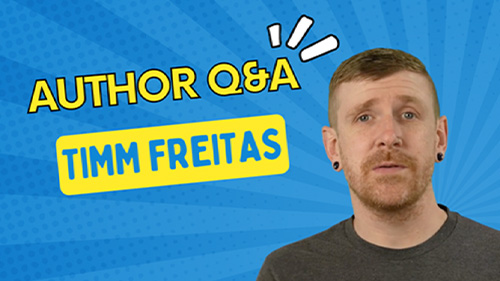
Want to learn more about author and Garden of English creator Timm Freitas? Tune into our new Author Q&A series! Learn who inspired to become a...

1 min read
As artificial intelligence becomes increasingly accessible, many teachers are asking the same question: How do we teach students to think for...

1 min read
With an emphasis on close reading, analysis, and full-length essays, losing track of sentences is easy. Join Dr. Brandon Abdon, author of our AP®...

1 min read
This resource is designed to provide a guided lesson on close reading, specifically imagery, figurative language, word choice, tone, and tonal shift...

1 min read
In this creative and analytical lesson, students will explore character development, relationships, and key events in a literary text by crafting a...