


 View Cart
1 min read
Turn Data Into Stories—Teaching AP Statistics Through Real-World Scenarios
AP Statistics can feel abstract for students—formulas, distributions, and probability rules can easily become a maze of procedures. But when data is...

2 min read

Great coaches and teachers try to differentiate their approach to each player/student to help them achieve their very best (on the field, court, or classroom). We learn early on that altering the learning environment just a bit can pay large dividends in student success and efficacy. Below are five differentiation strategies I’ve built into my precalculus course: scaffolding with parallel words and math, using emojis to simplify function notation, using color for visual learners, catching mistakes through counterexamples, and pushing and pulling students across skills, concepts, and calculus previews.
How many times has a student said to you, “I understand you in class, but when I get home, I’m lost?” And they can show you their notes from class which have all the math correct. So, what is missing? YOUR VOICE.
Here is an example: on the left is what you would say in class and on the right is what you would write on a board. I started making worksheets that had either the words or the math and the student had to fill in the other side (scaffolding allows the student to only focus on one part at a time).
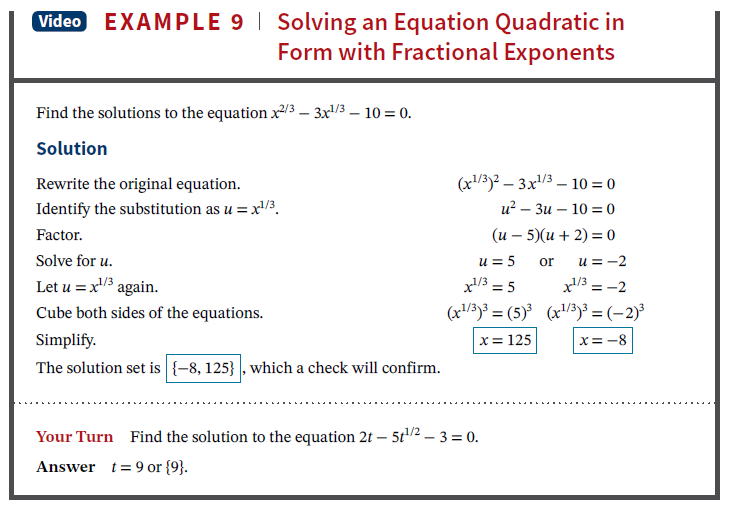
Sometimes when things get complicated, emojis can simplify. Looking at an example, if

Find:
a. f(-1)
b. f(x+1)
The student can quickly find that f(-1) = 1, but when asked about something more complicated like f(x+1) they don’t “see it.” That’s where emojis come in and the word “whatever.” “f of x is 2 times whatever cubed minus 3 times whatever squared plus 6. It doesn’t matter if whatever is x or my hand or an emoji:
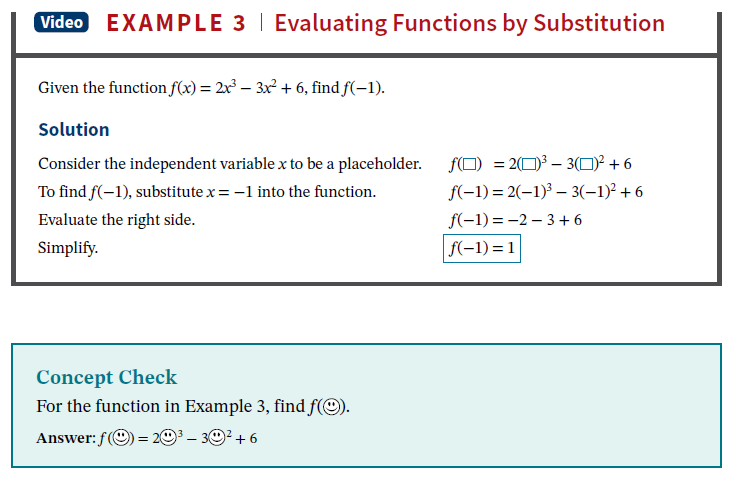
So then instead of your hand or whatever, an emoji can be substituted in the given expression, as in this Concept Check above.
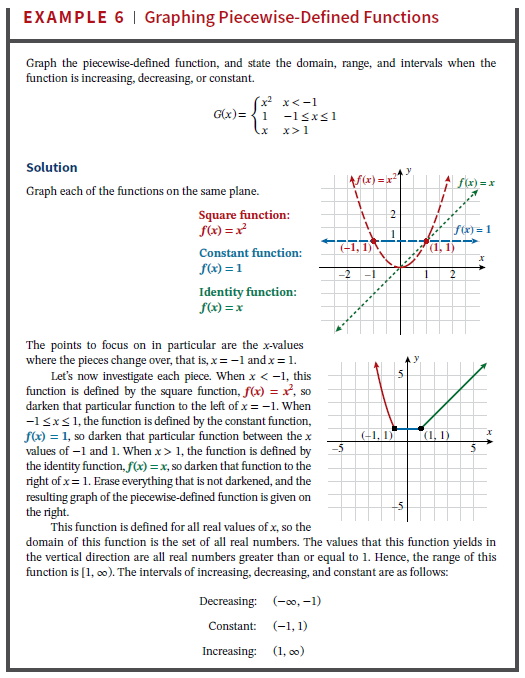
There are times when color can be utilized for pedagogical reasons. Colorization can help visual learners break complex tasks into bite-size chunks. In this example, graphing piecewise-defined functions can be seen using red for graphing the square function, blue for the constant function, and green for the identity function in the same plane.
Teaching by counterexample was described as an effective tool for developing deeper conceptual understanding in our blog “Catch the Mistake for Class Discourse and Productive Perseverance.”
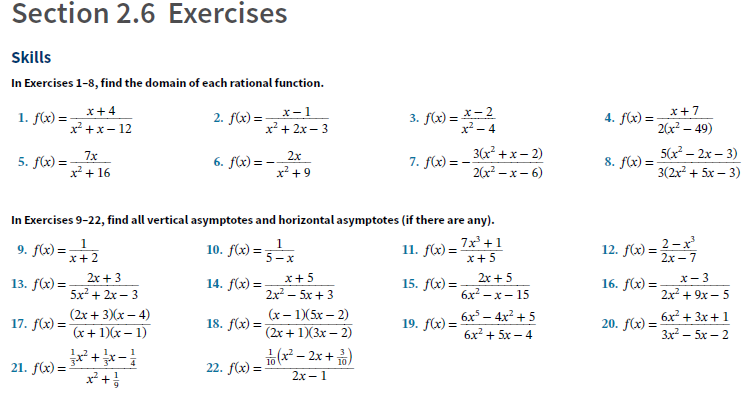
In every class, students are in different places in their knowledge and confidence. Every day that continuum changes. As nimble teachers, we often find ourselves pulling and pushing. Balancing skills and concepts with applications is important for basic understanding (pulling), but to push students to challenge and experience a glimpse of what’s next in a preview to calculus are ways to prepare students for the rigor of college-level mathematics.
Here are examples of this in rational:
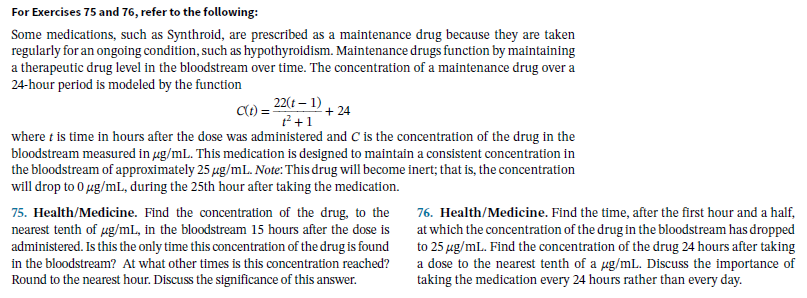
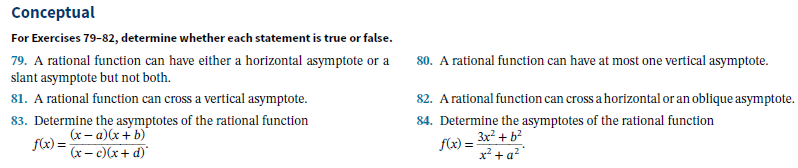
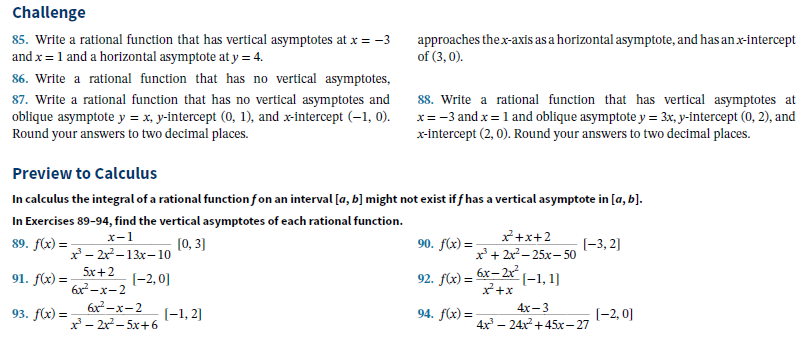
I have taught traditional high school, convicted felons, GED, community college, and at an R1 university. All these differentiators came out of trying to turn a 350:1 or 25:1, or even 10:1 student-to-teacher ratio into a 1:1 ratio. These integral parts of the program increase accessibility through differentiation, while maintaining rigor and finding a way to “pull up” or support some and “push” or challenge others along the way. Teachers have the flexibility and autonomy to utilize the components that best fit students’ needs.

1 min read
AP Statistics can feel abstract for students—formulas, distributions, and probability rules can easily become a maze of procedures. But when data is...

1 min read
We’ve all been there, a student brings you their attempt at a problem, and they ask you to find what they did wrong. You review it, can’t seem to...

1 min read
We’ve all been there, halfway through an amazingly planned (and executed!) lesson on the chain rule when everything comes grinding to a halt—not...

1 min read
AI in Industry A friend of mine is a vice president at a large construction company. Another is a software engineer. Like me, both received their...

1 min read
Any distance runner will tell you that preparation for a longer run like a 10k or marathon incorporates not only distance training, but sprints as...

1 min read
In today’s advanced math classrooms, rigor is accessed through multiple representations. Join this dynamic edWebinar designed for AP and Honors math...

1 min read
This resource is designed to provide structure, guidance, and inspiration for students to complete a series of dialectical journal entries based on...

1 min read
December is a unique month in the classroom. Energy is high, schedules are unpredictable, and instructional time can feel fragmented. But it’s also...

1 min read
In my first period class of sophomores at a high school on the Southwest side of San Antonio, I had one White student, one Muslim student, and the...

1 min read
December always asks a lot of us.

1 min read
Organization and clear communication are essential features of any classroom—really, any functional relationship. Staying on track, pacing a course,...

1 min read
Today's students consume stories through texts, emails, social media posts, screenshots, voice messages, and online conversations. Yet many still...