


 View Cart



1 min read
Catch the Mistake for Class Discourse and Productive Perseverance
We’ve all been there, a student brings you their attempt at a problem, and they ask you to find what they did wrong. You review it, can’t seem to...

4 min read
A friend of mine is a vice president at a large construction company. Another is a software engineer. Like me, both received their education in the pre-digital era, growing up in an analog world before entering adulthood in a digital one. Today, both use AI daily, and that background may be more relevant to how they use it than it first appears.
Like many teachers, I’ve been wrestling with AI’s impact on education. AI is becoming a daily part of life, so ignoring it would be a disservice to our students. At the same time, we’ve seen the negative impact AI can have on learning when, for example, a student feeds an entire assignment into an AI tool and submits the output as their own. Math becomes an exercise in copy-and-paste rather than problem-solving. That’s hardly preparation for a career.

So, I began to wonder. What are my friends with successful careers in industry doing differently that makes the human element essential?
I asked them both how they use AI and got similar answers. Their deep experience in construction and software development allows them to give AI the context, direction, and key ideas it needs to tackle complex tasks, from preparing project bids to building new apps. Just as importantly, they draw on that expertise to evaluate, refine, and improve the results. As the software engineer put it, AI has “given him a jetpack” in terms of what he can now accomplish.
The takeaway: AI needs direction, and its output needs to be evaluated. It can dramatically increase efficiency, but human expertise remains essential. As AI grows more capable, so does the value of deeply understanding the problem you’re trying to solve, thinking critically, exercising sound judgment, and turning AI’s output into meaningful solutions.
Preparing students for this future means teaching them to use AI thoughtfully and effectively. As math teachers, we have a unique opportunity to develop these skills by integrating AI into problem-solving activities that emphasize reasoning, evaluation, and real-world applications. By carefully crafting problems, like these, we can help students learn to use AI as a tool for thinking rather than a shortcut around it. We, too, can give our students a jetpack!
So, where does AI fit into a math class? Thinking back to my friend’s approach: they use their expertise to guide AI through complex problems then check the results and make adjustments as needed. Can we replicate this process in a classroom?
Absolutely. We can show students how to use AI to help solve problems that would otherwise be almost impossible, or in the very least tedious, to solve by hand—problems that are grounded in meaningful, real-world, and relevant-to-students data making them more engaging while still developing the skills we already teach in calculus. Students can use their mathematical knowledge to guide AI, evaluate its solutions, and refine the solutions when necessary.
The following is a problem you might see in a current Calculus text: the idea is to use Riemann sums to approximate the internal volume of a pair of fully inflated lungs—called total lung capacity—using slices.
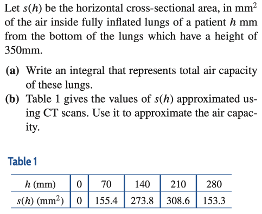
With AI, we can make this problem more engaging to the student and reflective of what they might see in a work environment, ensuring that they build the career-ready skill of engaging an AI using their expertise as a guide. As you read, feel free to try the problems yourself!
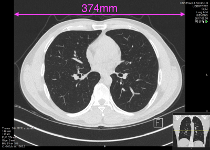
Instead of a table, we can give the students a real CT scan of a horizontal cross-section of a pair of lungs such as the one in Figure 1, where the internal part of each lung is the black oval-like areas surrounded by white.
Before engaging with AI, students should first develop an intuitive sense of answers they might expect. A good starting point is to imagine their own lungs as rectangular boxes and estimate their total volume. Next, provide students with a CT scan and ask them to approximate the internal cross-sectional area of the lungs by hand, using the image’s known width of 374 mm. A reasonable estimate is 280 cm². They can then use this estimate to approximate the volume of a 3-cm thick slice of lung. These preliminary estimates give students a mathematical basis for judging whether an AI-generated result is reasonable. We could then ask: How might you use this information, together with other CT scans, to estimate total lung capacity?
|
Figure 1 : CT Scan of a Lung |
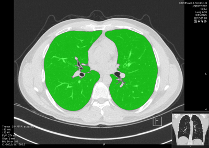
Figure 2: AI Calculated Area of Lung |
And now comes AI! By providing the CT scan and its pixel scale, we can ask AI to estimate the area of the cross-section in the CT scan inside the lungs. When I tried this myself, the AI also generated Figure 2, highlighting the calculated area in green. Give it a try! In my case, the AI gave me an area of 298.4 cm², remarkably close to my original by-hand estimate of 280 cm². Just as I used my own estimate to evaluate the AI’s result, students can compare its answer with their own work to judge whether it is reasonable.
We can take this a step further by using AI to estimate total lung capacity from multiple CT scans, building up a model of the lungs slice by slice—as many slices as we have access to. For example, here you can find 11 CT scans, representing slices of a pair of lungs every 3 cm, enough to produce a reasonable estimate of total lung capacity. More ambitious students can work with 106 slices, each just 3 mm thick, to construct a much more detailed and accurate model found here.[1]
The main point: students understand what the AI is doing, and they can push back if the answers they see are unreasonable. They're using it to tackle a task that would be difficult, though not impossible, to complete by hand and one whose results they can check against their own mathematical reasoning. Even better, estimating lung capacity this way reflects a real-world application of medical imaging.[2] Aspiring health professionals can explore a problem relevant to their future careers, right in their calculus classroom!
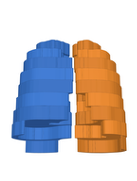
A simple follow-up prompt can direct the AI to build 3D models of the lungs with different numbers of slices; see Figures 3-5. Students can then see for themselves how adding more slices improves the approximation provided by a Riemann sum.
|
|
|
|
|
Figure 3: 3D Rendition of Lungs with 11 Slices |
Figure 4: 3D Rendition of Lungs with 106 Slices |
Figure 5: 3D Rendition of Lungs |
AI may not yet be part of the calculus curriculum, but why wait? If it sparks your interest, consider using the lung problem in your classroom—as a standalone activity or as part of an extended project. You can preview other problems slated for the ninth edition of Calculus here. If you give these problems a try, we’d love to hear what you think and how you’ve used them with your students. Most of all, did your students feel that AI had given them a jetpack of their own?
[1] CT scans from wikimedia by Mikael Häggström, MD., CC0 1.0 Universal Public Domain Dedication. Date accessed: May 14, 2026. More information here.
[2] Schultz et al. (2020). “Workflow-centred open-source fully automated lung volumetry in chest CT.” Clinical Radiology, 75(1), 78.e1–78.e7, https://pubmed.ncbi.nlm.nih.gov/31587801/
Aaron D. Wooton is

1 min read
We’ve all been there, a student brings you their attempt at a problem, and they ask you to find what they did wrong. You review it, can’t seem to...

1 min read
Any distance runner will tell you that preparation for a longer run like a 10k or marathon incorporates not only distance training, but sprints as...

1 min read
think of teaching an AP Course, especially AP Literature, as similar to training for an endurance sporting event. The first several months you are...

1 min read
AP Statistics can feel abstract for students—formulas, distributions, and probability rules can easily become a maze of procedures. But when data is...

1 min read
Every time I open up Instagram, Facebook, or Twitter, I’m given the option to post to stories or urged to open the stories of others. Pictures that...
1 min read
Primary sources provide students with a personal window into the past, enabling them to view history as human stories rather than a list of facts....

1 min read
Early in a school year it can be a real challenge to know how to begin teaching students critical skills they need to score on the AP® U.S. History...

1 min read
As a public educator, one of the most vital things that I try to get my students to understand is how all the information they learn works together...

1 min read
We’ve all been there, halfway through an amazingly planned (and executed!) lesson on the chain rule when everything comes grinding to a halt—not...

1 min read
In today’s advanced math classrooms, rigor is accessed through multiple representations. Join this dynamic edWebinar designed for AP and Honors math...

1 min read
During Pride Month, everyone expects coming out stories or rainbow flags to take over their social media profile pics–and honestly, I love those...

1 min read
An exit ticket can be an effective way to determine if students are understanding what they are being taught. They provide immediate feedback, while...